
Wellbeing Workshops in Huddersfield for Stress and Resilience
Resilience grows through skills people can use in everyday life, not simply through understanding stress. Wellbeing workshops in Huddersfield cover topics such as sleep, healthy eating, stress and anxiety, alongside practical approaches to managing pressure and strengthening personal resilience.
It’s understandable to look for support that feels relevant to daily life and offers more than general advice. Workshops provide a structured, supportive setting to explore wellbeing and develop skills for relationships, work and community life.
This guide outlines topics wellbeing sessions may cover, the resilience skills they can help develop and how to take part. It also explains what to consider when choosing a session, so you can find a useful next step for your circumstances.
Table of Contents
Workshop topics including sleep, healthy eating, stress and anxiety
Wellbeing workshops can address everyday factors that shape health and wellbeing, including sleep, healthy eating, stress and anxiety. Each topic offers a practical starting point: noticing patterns, identifying challenges and considering manageable changes. For example, a sleep discussion might explore evening routines, while a healthy eating session could consider how meal planning fits into daily life. These are learning topics, not a substitute for individual medical advice.
Sessions on stress and anxiety can help people recognise difficult situations and consider responses suited to their circumstances. An activity might involve identifying a source of pressure, noticing its effect on daily routines and choosing a small coping strategy to practise. Group discussion also lets participants learn from different experiences without treating one person’s approach as right for everyone.
For refugees and asylum seekers, mental health support needs to recognise how language, culture, displacement and uncertainty can shape experiences of stress. A welcoming session explains its purpose clearly, respects personal boundaries and avoids assuming participants share the same history or needs. Practical learning might include identifying trusted sources of support and discussing how everyday routines can provide structure during periods of change.
Mental health and wellbeing partnership work in Kirklees can connect community-based learning with wider support pathways. It helps to understand what a workshop can offer and where its role ends. A group session can support discussion and skills development, but it is not clinical mental health treatment. Clear boundaries help participants distinguish shared learning from individual care.
Qualified health professional supervision matters when a session includes health information, risk concerns or advice that could affect someone’s care. It can help facilitators stay within their role and respond appropriately when a participant needs more individual support. For example, a workshop on anxiety can focus on general coping skills, while personal clinical concerns belong in a suitable health-care setting. This distinction supports safe, transparent learning.
Across Kirklees, consider whether a session’s subject matches your immediate learning goal: sleep routines, food-related habits, stress responses or anxiety. Partnership working is most useful when community organisations understand their roles and make support pathways clear. That clarity can help people seeking mental health and wellbeing support decide whether a workshop offers relevant group learning or a different form of support is more appropriate.
The 2024 Mental Health Awareness Week ran from 13th - 19th May 2024. Kirklees Council's social isolation awareness introduction takes 5 to 10 minutes, offering a brief starting point.
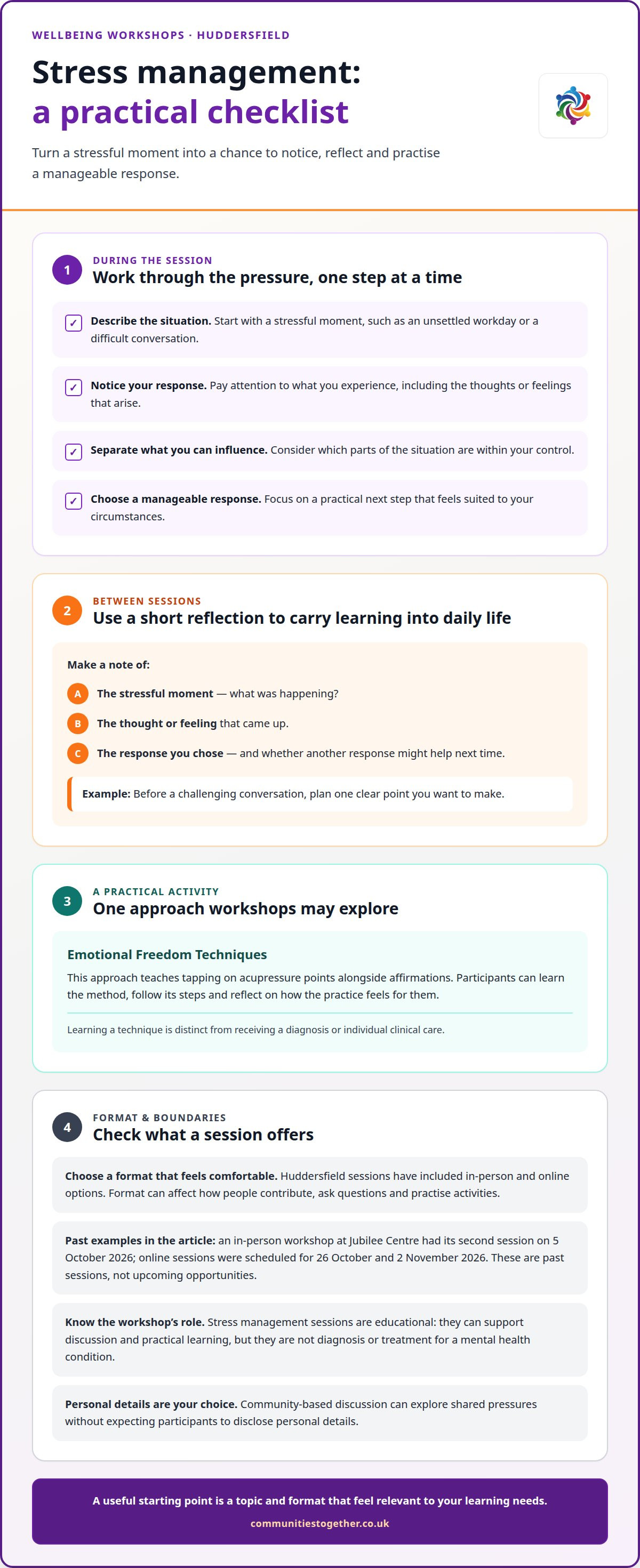
Stress management
Stress management sessions can help participants identify pressures and practise ways to respond. Start by describing a stressful situation, such as an unsettled workday or a difficult conversation. Notice what you experience, consider what is within your control, then choose a manageable response. This structured reflection turns a broad subject into practical learning without assuming everyone faces the same pressures.
Huddersfield sessions have included in-person and online formats. The in-person Stress Management workshop at Jubilee Centre had its second session on 5 October 2026. Online sessions were scheduled for 26 October and 2 November 2026. These dates show how delivery can vary by format; they are past sessions, rather than upcoming opportunities. A workshop or course may use discussion and exercises to help participants examine stress responses.
One approach is Emotional Freedom Techniques, which teaches tapping on acupressure points alongside affirmations. In a workshop, participants can learn the method, follow its steps and reflect on how the practice feels for them. The activity gives a session a practical focus beyond discussion alone. Learning a technique is distinct from receiving a diagnosis or individual clinical care.
Between sessions, a simple reflection can connect learning with everyday situations. Note the stressful moment, the thought or feeling that arose and the response you chose. Then consider whether another response might help next time. For example, someone preparing for a challenging conversation could plan one clear point beforehand. This process helps make workshop learning relevant beyond the group.
Some people prefer a friendly group setting, while others feel more comfortable participating online. The format can affect how people contribute, ask questions and practise an activity. Clear information about a course’s purpose and structure helps participants decide what suits their learning needs. Stress management workshops are educational, not diagnosis or treatment for a mental health condition.
For community organisations, stress-related learning can also support shared understanding: participants can discuss common pressures without being expected to disclose personal details. A facilitator can guide the conversation towards practical strategies, respectful listening and clear boundaries. People interested in community-based learning can explore community partnership work as one route to strengthen local connection. The best starting point is a topic and format that feel relevant.
Wellbeing skills and resilience
Resilience can grow through skills that help people understand feelings, make choices and respond to change. A wellbeing programme may combine reflection with practical exercises, giving groups a clear way to explore personal values and everyday goals. For example, participants might identify a quality they want to use more often, then consider how it could support a decision. This connects learning with life beyond the session.
The Wellbeing Skills Workbook covers resilience, emotional regulation, goal setting and exploring personal values. Use these themes as prompts: notice an emotional response, consider what matters in the situation, then identify a next step. A goal might be speaking up in a meeting or maintaining a meaningful routine. The workbook offers a structure for reflection, not a single formula for everyone.
For people coming to a group to build confidence, the Huddersfield Confidence Workshop is a one-day session. It covers self-esteem, body language and personal values. These subjects can be explored through examples, such as how posture affects communication or how personal values inform a choice. The online Self-Esteem and Resilience workshop had its second session scheduled for 1 October 2026, offering another example of focused learning.
Assertiveness skills can help participants practise expressing a view clearly and respectfully. The Assertiveness Workshop is a three-hour session offering six practical strategies for everyday use. A practice scenario could involve asking for clarification or communicating a preference. The aim is to develop ways of speaking up confidently while recognising that participants bring different relationships, responsibilities and communication styles.
Other courses explore emotional awareness and self-management in more depth. The six-week Anger Management Course uses CBT principles to explore anger and ways to manage it. The Mindfulness Course covers present-moment awareness, self-compassion and the Five Ways to Wellbeing. These offer different learning routes: one examines anger and responses, while the other develops attention and a kinder approach to personal experience.
Creative and reflective activities can also support shared learning. The Quarterly Women’s Circle includes grounding breathwork and a closing activity, such as meditation or poetry. A closing practice gives participants a defined way to finish, while breathwork offers a focus for attention. These workshops and courses provide skills-based learning, not a substitute for clinical mental health treatment. Choose a topic that aligns with the skills you want to develop.
Because the Assertiveness Workshop is a 3-hour session with practical strategies for speaking up confidently, participants can consider each strategy in context rather than treat it as a fixed script. The useful question is not only what to say, but how to make a message clear while remaining attentive to the other person. Reflection after practice can help identify which wording feels authentic and what might be adjusted next time. In this way, confidence is approached as a skill to develop, not a demand to act the same in every exchange.
Which organisations run wellbeing workshops in Huddersfield?
Huddersfield’s wellbeing provision involves community groups, local partnerships and public bodies, with different roles across support and funding. S2R’s work is funded by Kirklees Council and NHS Integrated Care Board. This identifies the funders, rather than meaning either organisation directly runs every session. For a reader choosing a workshop, it helps to distinguish the group delivering an activity from the partnership or body supporting wider provision.
Working Together Better is one named local partnership connected with group activities. Its 18-30s Group is for young adults aged 18-30 who are accessing support through the partnership. Activities change weekly and may include arts and crafts, games and projects. This example shows how a community group can offer structured activities alongside opportunities to connect, rather than focusing only on a single wellbeing topic.
Some sessions are recurring groups, while others are set workshops. Mindful Mondays meets every Monday at Dewsbury Connect, with guided meditation, relaxation practices and conversation. The Quarterly Women’s Circle meets once a season and is open to women across the Working Together Better services. These examples show different ways to participate: a regular weekly group or a less frequent shared session.
Specific workshop listings can also show the range of subjects and formats available locally. Examples include Stress Management, Assertiveness and Communication, Food and Household Budgeting, and Coping with Christmas. Some are online, while other activities take place in person. Their titles indicate practical areas of focus, from managing pressure to communicating more confidently, without suggesting that every organisation delivers every topic.
To identify an appropriate route, start with the type of support sought. A person interested in a recurring social group can look at the group’s eligibility and activity pattern. Someone seeking a particular skill can focus on a named workshop topic and its delivery format. If a listing is linked to a partnership, its access criteria may be relevant; the 18-30s Group, for example, is for young adults accessing support through Working Together Better.
Funders, partnerships and session organisers therefore contribute in distinct ways to Huddersfield’s wellbeing landscape. Kirklees Council and NHS Integrated Care Board fund S2R’s work, while Working Together Better is associated with a group for eligible young adults and services spanning women’s activities. Comparing purpose, audience, subject and format helps readers understand which listing best matches their needs, without treating a funding body as the workshop facilitator.
Where and when are Huddersfield wellbeing workshops held?
Sessions use both local venues and online formats, so location and travel can shape which dates are practical. In Huddersfield, the Media Centre hosted an in-person Volunteer Taster Session scheduled for 9 November 2026. Jubilee Centre hosted an in-person Stress Management workshop, with its second session scheduled for 5 October 2026. These dates have passed, but they show the range of venues used.
The Media Centre also hosted two in-person sessions in October 2026: Coping Skills on 8 October and Retention in Work on 15 October. These examples show how a workshop may be organised around a particular subject and a specific venue. For each listing, note whether it is online or in person, then check the location and session date against your own commitments.
Some sessions follow a regular pattern rather than a single date. Monthly yoga sessions are held on the last Friday of each month, giving participants a recurring time to plan around. Online Words in Mind meets every Tuesday from 11am to 12pm, while Your Voice in Kirklees Magazine meets every Wednesday from 12.30pm to 2pm. The format and set time distinguish these groups from one-off workshops.
Other schedules are organised as a sequence of dates. Online Ways to Wellbeing sessions are scheduled for 30 November and 7 December 2026. Mood and Food is scheduled online for 16 and 23 November. Stroll and Snap to Wellbeing has online sessions scheduled for 27 October, 24 November and 15 December. The October date has passed; the later dates remain in the listed schedule.
Denby Dale also features in the programme. In-person Confidence to Work sessions were scheduled for 9, 16, 23 and 30 October, then 6 and 13 November 2026, at a venue to be confirmed. A separate in-person Volunteer Taster Session there was scheduled for 20 November, also at a venue to be confirmed. These listings show why the town and venue details matter alongside the date.
To compare sessions, sort their details by format, place, topic and timing. An online session may remove the need to travel, while a Huddersfield venue may suit someone seeking face-to-face participation. Recurring groups require attention to their weekly or monthly pattern; dated workshops require checking each session. This helps distinguish a one-off event from a continuing commitment.
Before making plans, use the session listing to identify its exact date, delivery format and named venue. This is especially useful where a schedule includes several sessions or locations. The dates above include past and upcoming entries from the 2026 programme, so distinguish them carefully when planning attendance.
Communities Together: Wellbeing and Resilience Workshops
Communities Together offers Wellbeing and Resilience Workshops for people seeking a structured setting to develop everyday wellbeing skills and resilience. These community-based sessions provide a next step for readers interested in learning, reflection and shared participation, rather than clinical mental health treatment.
Communities Together’s wider community engagement work connects wellbeing with the relationships and strengths that support local groups. South Asian Arts and Heritage Activities and Heritage and Cultural Preservation also foster connection through shared cultural activity. In Huddersfield, Halifax, Leeds, Bradford and Wakefield, Communities Together’s wellbeing and community programmes offer opportunities for learning and participation.
Take a considered next step towards wellbeing
Choosing a session can begin a wider process: identifying what feels useful now, taking part in shared learning and deciding which skills to use in everyday life. If you’re considering wellbeing workshops in Huddersfield, connect the topic that matters most with a setting that feels comfortable and accessible.
You might want to practise responding to pressure, build confidence in expressing your needs or strengthen connections through community learning. You don’t need to define every goal in advance. Starting with one area of interest can make participation purposeful while leaving room for new perspectives and learning.
Communities Together welcomes enquiries from people interested in a next step through its wellbeing and community work. Get in touch to begin a conversation about taking part.
A thoughtful first step can make space for learning, connection and resilience to grow.
Frequently Asked Questions
What sessions are available in Huddersfield?
Wellbeing workshops in Huddersfield include sessions on sleep, healthy eating, stress, anxiety and coping skills. Listings also feature topics such as confidence, assertiveness and emotional resilience. Some sessions are online, whilst others take place in person at local venues. Availability changes with the programme, so use the current session information to identify upcoming dates, the delivery format and any application or referral route.
What subjects and formats can I choose from?
Options can include practical skills workshops, longer courses and recurring community groups. For example, Emotional Freedom Techniques introduces tapping on acupressure points alongside affirmations, while mindfulness learning explores present-moment awareness and self-compassion. Assertiveness sessions focus on ways to speak up confidently. Consider whether you want a one-off learning experience, a course or regular group participation.
Who can attend, and are there eligibility requirements?
Eligibility depends on the individual session. For example, the 18-30s Group is for young adults aged 18-30 accessing support through the Working Together Better partnership. The Quarterly Women’s Circle is open to women across Working Together Better services. These examples don’t establish eligibility for every workshop; read the relevant session details to understand its intended participants and whether an application or referral is needed.
How do I book a session?
Start by selecting a session, then follow the application or referral route described in its information. Note its topic, format, date and venue before submitting an application or discussing referral with the relevant organisation. If you’re considering a Communities Together workshop, use its contact page to enquire about taking part. The session’s own instructions determine the appropriate next step and any information required.
What should I consider before attending, including risks or qualifications?
Before attending, consider whether the topic and activities feel suitable for you, and read the session information about the facilitator’s qualifications and format. Activities may include breathwork, tapping, meditation or group discussion, so reflect on your comfort and boundaries. Wellbeing workshops in Huddersfield offer learning and support, not clinical diagnosis or treatment. You can contribute to discussion at a level that feels manageable.

Comments