
Wellbeing workshops in Bradford: timings and group visits
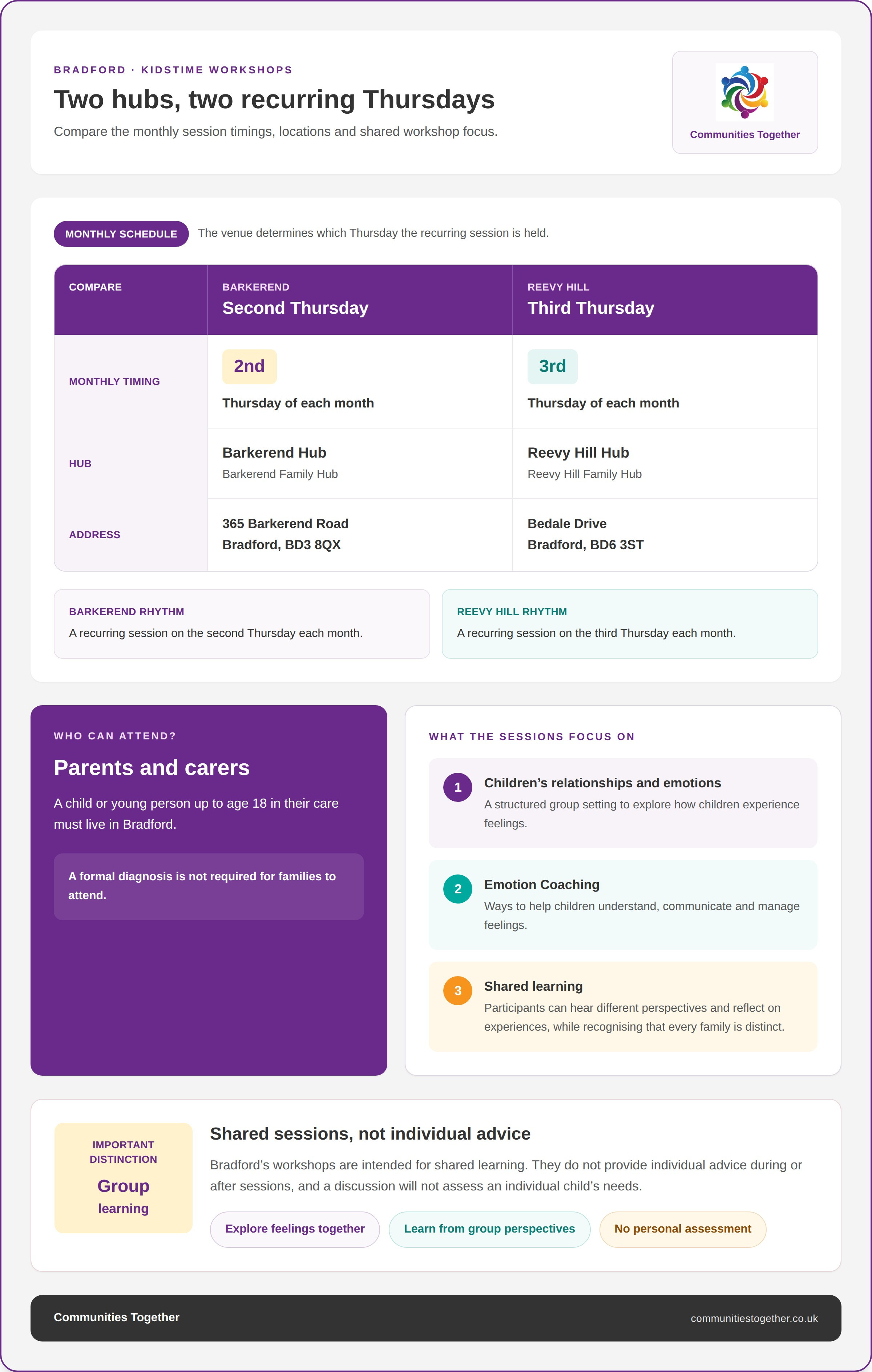
Wellbeing workshops in Bradford vary in their schedules and focus. KidsTime Workshops at Barkerend Hub take place on the second Thursday of each month, while sessions at Reevy Hill Hub are held on the third Thursday. These recurring dates are a useful starting point, but other workshops and group visits may follow different arrangements.
Choosing a session involves more than finding a suitable time. The group format, topics and cultural context can all affect whether a workshop feels relevant and encourages connection. Families don’t need a formal diagnosis to attend KidsTime Workshops, which focus on children’s relationships and emotional wellbeing.
This guide covers the Bradford workshop timings discussed here, what to expect from group sessions and how to plan a visit. It also explains how culturally responsive wellbeing and resilience activities can support understanding, connection and shared capacity, helping you find an approach that fits your group.
Table of Contents
Benefits of attending
No single Bradford workshop suits every concern about stress, anxiety or mental health. KidsTime Workshops focus on children’s relationships and emotions, using a group format for shared learning rather than individual advice. Choose a session based on its stated focus and intended participants.
Parents and carers can attend if a child or young person up to age 18 in their care lives in Bradford. A formal diagnosis isn’t required for families to attend KidsTime Workshops. School staff and professionals may attend only in their capacity as a parent of a young person living in Bradford.
The recurring KidsTime dates can help families plan attendance: Barkerend Hub holds its workshop on the second Thursday of each month, and Reevy Hill Hub holds its session on the third Thursday. Barkerend Family Hub is at 365 Barkerend Road, Bradford, BD3 8QX. Reevy Hill Family Hub is on Bedale Drive, Bradford, BD6 3ST.
A workshop about relationships and emotions gives families a structured setting to explore how children experience feelings. For example, a parent might consider how a child responds to frustration and discuss ways to recognise and communicate that feeling. This can build understanding without treating one family’s experience as universal.
Emotion Coaching is another practical focus. Parents learn ways to help children understand, communicate and manage feelings. This links emotional awareness with everyday interactions, such as listening when a child is upset and helping them name what they feel. The emphasis is on learning together, not receiving a personal assessment.
Group participation also creates space to hear different perspectives. A parent may recognise a familiar challenge in another family’s example or find a new way to describe an emotional situation. Sharing experiences can encourage reflection and connection while respecting that every child and family has distinct circumstances.
Before attending, consider the group format and the session’s purpose. Bradford’s workshops don’t provide individual advice during or after sessions, so they’re intended for shared learning rather than one-to-one guidance. A discussion may introduce ideas about emotions, for example, but it won’t assess an individual child’s needs.
The benefits depend on matching the workshop to the question a family wants to explore. A parent seeking insight into children’s emotions may find KidsTime relevant, while someone needing individual advice requires a different kind of support. Bradford’s recurring sessions offer a starting point for exploring family relationships and emotional understanding.
For questions about a child’s feelings or family relationships, KidsTime’s relationships-and-emotions workshops and Emotion Coaching are the closest fit. They offer shared learning about understanding and managing emotions, rather than individual mental health advice or assessment.
Community connection and social isolation
Social isolation can mean having few opportunities to take part, even when other people live nearby. In Bradford, a shared workshop can provide a welcoming setting for conversation, listening and participation. A group activity, for example, gives attendees a common focus, which can make it easier to start talking than at an unstructured meeting.
Connection grows through repeated opportunities to participate, not simply by bringing people into one room. A session might invite attendees to share a skill, discuss a local concern or take part in a creative activity. Participants can contribute at a comfortable level while the facilitator makes space for different experiences and viewpoints.
Bradford’s social prescribing work offers a wider local context: 30 projects were planned across the year as part of Bradford’s UK City of Culture programme. Social prescribing connects people with community-based activities and support. This approach recognises that local relationships and meaningful participation can form part of a broader response to social challenges.
A well-structured group session can guide participants from introductions towards a shared purpose. A facilitator might begin with a paired discussion, then invite the group to identify common interests. This gives quieter attendees more than one way to contribute, without asking anyone to speak for an entire community.
For a group visit, first identify what connection should look like in practice. A neighbourhood group may value building new relationships, while a community organisation may want members to exchange ideas and grow their confidence working together. Sharing this aim with the facilitator can help shape activities around the group, rather than expecting everyone to engage in the same way.
A clear next step after the session can help maintain contact. Participants might agree to attend another community activity, share information with someone who could benefit or continue a conversation through an existing local group. These are possibilities, not guaranteed outcomes; their value depends on what participants find relevant and accessible.
For Bradford groups seeking a structured way to participate and collaborate, community engagement programmes can provide a relevant starting point. A suitable programme can bring people together around shared interests, local knowledge and collective priorities, helping turn one session into a more sustained opportunity for connection.
Culturally responsive wellbeing projects
Bradford wellbeing projects use different formats and themes to encourage participation. The right fit depends on who the session is for and what the group wants to explore.
Online and in-person formats
Bradford’s parent and carer workshops take place online via Microsoft Teams. Other wellbeing activities may use different settings, so check the format for the specific session. For an online workshop, participants join remotely; a group visit involves attending together at an arranged place. The format shapes how people take part and interact.
Workshop topic choices
Bradford’s parent workshops cover themes such as children’s relationships and emotional wellbeing. For a culturally responsive project, organisers can identify topics relevant to participants’ experiences, interests and community context. A group might explore how shared heritage influences belonging or use a creative activity to open discussion. Clarifying the topic helps participants understand the session’s purpose before attending.
Bradford 2025 announced over 30 creative health projects to address health and social challenges across the district. This provides a local example of creative approaches being used alongside wellbeing activity. For a group, a practical first step is to identify the intended outcome, such as shared learning, stronger relationships or opportunities to express ideas through cultural activity.
Cultural responsiveness means making room for participants’ knowledge and perspectives, rather than assuming a community has one shared experience. A facilitator might invite people to suggest themes, ways to participate or relevant creative practices. This helps reflect the group’s context while keeping the session’s purpose clear and accessible.
To arrange a place at a Bradford parent and carer workshop, contact the named coordinator before 12 noon. Once a place is confirmed, login details and passwords are sent nearer the session date. This sequence gives participants time to receive joining information and understand how to access the Microsoft Teams session.
When arranging a group visit, organisers can share the group’s purpose and preferred format. A school group, for example, may benefit from a planned activity that gives pupils different ways to contribute. A community group may prioritise discussion and shared reflection. Clear aims help shape a relevant session without assuming everyone wants the same experience.
Before booking, match the workshop topic and format to the participants. Bradford’s online parent sessions suit parents and carers exploring family-focused themes; creative health projects offer another local context for wellbeing activities. A clear purpose, a suitable format and space for diverse perspectives can help a group take part meaningfully.
Group size and visit duration
Group size and timing depend on the workshop’s format, activities and participants. Bradford Cathedral offers a local example of planning a school visit, but its recommendations aren’t a standard timetable for every wellbeing session.
Bradford Cathedral recommends allowing two hours for an ideal school visit. Organisers can use this as a planning reference for the whole experience, including time to participate and move between activities. The structure matters: a programme with several stations needs a different flow from one continuous group session.
At Bradford Cathedral, pupils are recommended to spend around 20 minutes at each wellbeing workshop station. That interval gives participants time to engage before moving on. A clearly communicated schedule can help a school group understand when each activity begins and how transitions fit into the visit.
The Cathedral divides pupils into three smaller groups to rotate around the first three wellbeing stations. This spreads participants across activities rather than gathering everyone at one station. For a school visit, smaller rotating groups can support participation, listening and coordinated movement through the programme.
These details show how group size and duration work together. A rotation plan depends on the number of stations, the activity format and the time needed to move between spaces. A school group visiting several stations, for example, needs time for transitions as well as participation at each one.
Other Bradford wellbeing events may follow a different structure. A single-session workshop can keep participants together, while a visit with several activities may need smaller groups and planned rotations. The event format determines how organisers allocate time, explain transitions and support participation.
For organisers, a practical planning sequence is to establish the visit’s purpose, find out whether activities are station-based, then allow time for participation and transitions. A school group might need a rotation schedule, while another group may take part in one continuous session. The programme design shapes the arrangements.
Group arrangements also affect participation. A large group moving together may need clear instructions and coordinated transitions; smaller groups can rotate through activities, as pupils do at Bradford Cathedral. The best approach depends on the session structure and participants’ needs, not a universal group-size rule.
When preparing a school visit, organisers can share the group’s learning aims and expected attendance with the session organiser. This helps inform activity flow, group rotations and time allocation. Bradford Cathedral’s two-hour recommendation, 20-minute station intervals and three-group rotation illustrate one local model, not a fixed timetable for every wellbeing workshops Bradford session.
Every session requires careful planning regarding group size or duration. The Wellbeing Workshop: Sleep Well in Ilkley ran from 19:00 to 21:00, illustrating a set event window rather than a station-by-station schedule. That timing can be considered alongside the format when estimating how much time is available for participation, movement and settling in. It does not make that duration a template for other programmes; organisers still need to match the timetable to the activities and group arrangements.
What topics do Bradford wellbeing workshops cover?
Bradford’s parent and carer workshops cover children’s relationships, emotional development and ways to understand feelings. These themes connect early relationships with how children make sense of and communicate emotions.
One focus is how a child’s early relationships affect their development and ability to manage emotions. A discussion might consider how a child responds when a familiar adult offers comfort or guidance. Exploring this connection helps parents reflect on emotional development in everyday family interactions.
Another topic is Emotion Coaching. Parents learn ways to help children understand and communicate their feelings, then manage them more effectively. For example, a parent might help a child name their frustration before discussing what could help. The aim is to build emotional understanding and communication through supportive conversations.
These topics are connected. A child’s relationships can influence how safe they feel expressing emotions, while a parent’s response can shape the conversation that follows. A workshop can explore these links through shared discussion, helping attendees consider how relationships and emotional communication work together.
Useful questions for parents to explore include what a child may be communicating through behaviour, how feelings can be acknowledged and what helps a conversation continue. For instance, Emotion Coaching encourages parents to help children identify and communicate feelings, rather than moving straight to solving the situation.
The focus on positive relationships also gives families a way to discuss connection alongside managing emotions. Parents can consider how trust, listening and communication affect a child’s ability to express feelings. These themes provide a shared framework for discussion while recognising that every family’s experiences and relationships differ.
Bradford’s parent workshops are group sessions, designed for shared learning rather than individual advice. This format suits parents and carers who want to explore children’s development and emotional communication with others. It doesn’t provide a personal assessment of a child or tailored guidance for one family’s circumstances.
When choosing a session, look at its stated topic and intended participants. A parent interested in early relationships may prioritise that theme, while someone seeking practical ideas about children’s feelings may focus on Emotion Coaching. Matching the session to your question helps clarify what you can explore and what the group format offers.
The workshop theme includes practical ideas for supporting children to build positive relationships and process, understand and manage their emotions. These connected aims cover both positive relationships and children’s emotional experiences. Together, they offer parents and carers a broad subject for reflection alongside the workshop topics already described, without implying every child or family approaches relationships and feelings in the same way. The emphasis is on support across both areas, not on one response that must suit every situation.
Communities Together: Wellbeing and Resilience Workshops
Communities Together offers Wellbeing and Resilience Workshops for groups seeking to strengthen connection, reflection and shared coping skills. These workshops are a relevant next step when your group wants structured wellbeing activities shaped around its purpose and participants. South Asian Arts and Heritage Activities can also create opportunities to explore culture, identity and community connection.
For a group visit, consider what participants hope to explore, such as resilience, relationships or shared heritage. This helps guide a workshop approach that supports collective learning and participation. Contact Communities Together to discuss your group’s wellbeing workshop needs.
Shape a meaningful next step for your group
The value of wellbeing workshops in Bradford can extend beyond a session when a group connects what it learns with its wider priorities. Consider what participants want to carry forward, whether that means making space for shared reflection, strengthening local relationships or creating opportunities for cultural expression.
Communities Together offers Wellbeing and Resilience Workshops, Community Engagement Programmes and South Asian Arts and Heritage Activities. These provide different ways for groups to explore wellbeing, participation and heritage together. Start by identifying what your group hopes to develop.
A thoughtful next step can turn shared interest into purposeful activity, shaped by the people taking part and the connections they want to build. Your group can begin the conversation at its own pace.
With a clear purpose and space for everyone’s perspective, your group can take a positive step towards stronger connections.
Frequently Asked Questions
When do the workshops take place?
KidsTime Workshops run monthly, with Barkerend Hub sessions on the second Thursday and Reevy Hill Hub sessions on the third Thursday. These recurring dates apply to those workshops; other Bradford wellbeing activities may have different timetables. If you’re planning for a group, identify the specific programme first, then use its schedule to coordinate attendance and transport.
What wellbeing workshops are available in Bradford, UK?
Bradford offers family-focused sessions, creative health activities, and wellbeing and resilience workshops. KidsTime and parent and carer sessions explore children’s relationships, development and emotions, while creative projects use participation to address health and social challenges. Communities Together also offers wellbeing and resilience workshops. Choose based on participants’ interests and the kind of shared learning or activity your group wants.
Which organisations run wellbeing workshops in Bradford?
Communities Together offers Wellbeing and Resilience Workshops, along with community engagement and South Asian arts and heritage activities. Bradford also has KidsTime Workshops, parent and carer sessions, and creative health projects. These are distinct programmes, so the organiser depends on the activity you’re considering. For community-based wellbeing activities, Communities Together’s workshops are a relevant option.
Where and when are wellbeing workshops held in Bradford?
KidsTime Workshops take place at Barkerend Family Hub, 365 Barkerend Road, BD3 8QX, on the second Thursday of each month, and Reevy Hill Family Hub, Bedale Drive, BD6 3ST, on the third Thursday. Bradford’s parent and carer workshops are delivered online through Microsoft Teams. The location and format therefore depend on the programme and session.
Comments