
Training for charity trustees in Leeds: duties and finance
What if the most useful training for charity trustees starts with the skills your board needs, rather than a generic course? Clear guidance can help you understand your responsibilities, especially when charitable purposes, financial oversight and collective decision-making all need attention.
Good training should clarify the six main trustee duties, how to follow your charity’s governing document, and how to contribute to decisions about budgets, fundraising, spending and financial controls. It should also help identify gaps in the board’s knowledge, so learning responds to your charity’s needs instead of covering familiar ground.
This guide explains what trustee training can cover, from charitable purposes and duties to financial responsibilities, and how to spot areas where further learning could strengthen your board. It also outlines free training resources and practical ways to assess trustees’ skills, helping you build an approach to governance that supports your charity’s work in Leeds and across West Yorkshire.
Table of Contents
Understanding charitable purposes and governing documents
Trustee learning starts with the charity’s purposes and governing document, which shape its work and decisions. In England and Wales, trustees must comply with their charity’s governing document.
Trustee roles and governance fundamentals
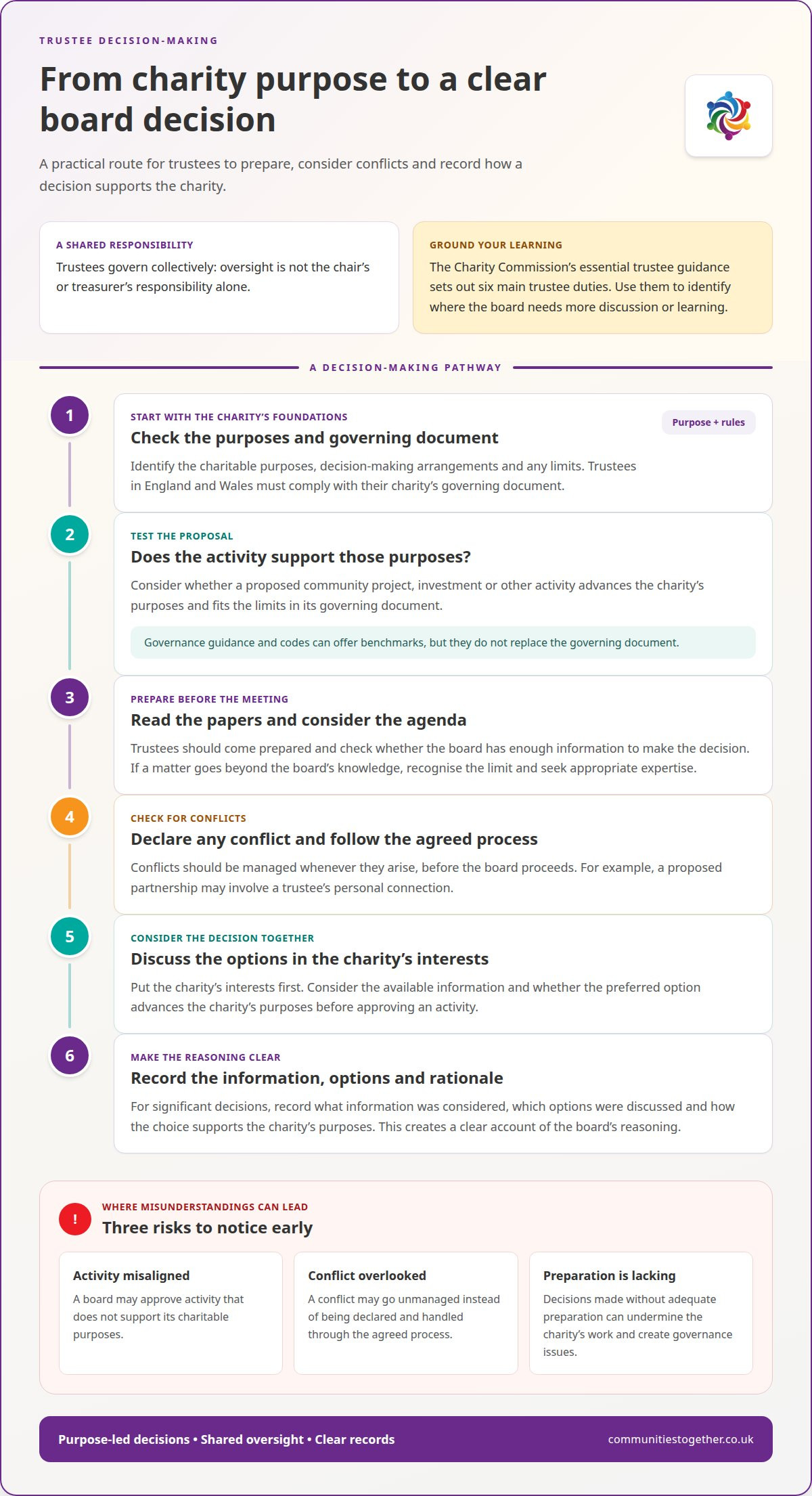
Trustees provide leadership by overseeing the charity’s direction, decisions and accountability. Start with the governing document: identify the charitable purposes, decision-making arrangements and any limits it sets. Then consider whether proposed activities, such as a community project or investment, support those purposes. Governance guidance and codes can offer benchmarks, but they do not replace the charity’s governing document.
Induction and governance training
A structured induction helps every new trustee understand the charity’s purposes, governing document and board procedures. Share key papers before their first meeting, explain how decisions are recorded, and identify the relevant safeguarding, finance and risk contacts. The Charity Commission’s five-minute guides on trustee duties and charity governance can support induction alongside discussion of the charity’s own policies.
What should trustee training cover on safeguarding, finance, governance and risk management? The content should reflect the charity’s activities, the people it supports and the decisions trustees oversee. For example, a board working with children should understand its safeguarding arrangements. Trustees should also learn how financial controls and risk reviews work in their charity.
Trustees should understand how changes to the charity are reported. Charities must tell the Charity Commission about changes to trustees, their governing document or their name, so the register entry stays accurate. A Charity Commission account is needed to report relevant changes. Including these steps in induction helps new trustees understand their role in maintaining accurate records.
Investment governance needs a clear link between the charity’s purpose, strategy and sustainability. Training can help trustees consider how an investment approach supports the charity’s objectives, how decisions are overseen, and what sustainability means for the chosen strategy. Use the charity’s own investment policy or a realistic example to show how responsibilities apply to decisions.
Charity and corporate governance codes can help boards review accountability, leadership and decision-making. Treat a code as a prompt for discussion: identify which principles fit the charity’s structure, then record any actions the board agrees. The governing document remains central, while a code can help trustees assess whether their processes support the charity’s purposes and effective oversight.
Charity trustee duties and liabilities
Trustees need a shared understanding of their duties to make decisions that serve the charity’s purposes. The Charity Commission’s essential trustee guidance sets out six main trustee duties.
Trustee roles and main duties
Trustees govern collectively. Oversight is not the chair’s or treasurer’s responsibility alone. Duties include putting the charity’s interests first and managing conflicts of interest whenever they arise. Use the six main duties to identify which responsibilities need more discussion, practical examples or further learning across the board.
Applying duties in practice
Apply each duty to real decisions, not just training notes. Before approving an activity, consider whether it advances the charity’s purposes and whether the board has enough information to decide. Trustees should read papers and consider agenda items before meetings. If a conflict arises, declare it and follow the charity’s agreed process before proceeding.
Are trustee training requirements different in Scotland and Northern Ireland? Training should reflect the jurisdiction in which the charity operates, as governance frameworks and relevant guidance can differ across the UK. Use learning that addresses the rules applicable to your charity rather than assuming England and Wales material covers every situation.
Charity law and trustee liabilities
Charity law provides context for trustee duties, but training should connect principles with board practice. For each significant decision, trustees can record the information considered, the options discussed and how the choice supports the charity’s purposes. This creates a clear account of the board’s reasoning. Trustees should also recognise the limits of their knowledge and seek appropriate expertise when a matter exceeds it.
Liability depends on the circumstances and the charity’s structure, so training should explain relevant responsibilities without suggesting every mistake has the same consequence. Trustees should understand the governing arrangements that apply to their role and the decisions they approve. Clear records, careful consideration and timely attention to conflicts help boards demonstrate responsible oversight.
Risks of misunderstanding trustee duties
What are the risks and consequences of trustees not understanding their duties? A board might approve activity that does not support its purposes, overlook a conflict or make decisions without adequate preparation. These failures can undermine the charity’s work, affect confidence among beneficiaries and supporters, and create governance issues that need attention.
Training should help trustees recognise risks early. Use a meeting scenario, such as a proposed partnership involving a trustee’s personal connection, to practise identifying the conflict and agreeing a fair process. Reviewing decisions afterwards can reveal where knowledge was lacking and what guidance might support better judgement next time. The aim is informed, collective leadership, with duties understood as part of everyday governance, not just formal reviews.
Financial reporting and internal financial controls
Financial oversight is a shared trustee responsibility, not a task reserved for the treasurer. Training should help the whole board understand financial reports and relate them to the charity’s plans.
Financial reporting responsibilities
All trustees are responsible for their charity’s finances, including trustees without accounting roles. They should understand budgets, financial plans, fundraising income and spending before approving decisions. A charity will most likely need to file an Annual Return with the Charity Commission every year. Trustees should know who prepares the return, what information informs it, and how the board reviews financial reporting.
Financial reports are most useful when trustees can relate figures to activity. Compare planned and actual spending for a project, then discuss any difference and its effect on delivery. Review income alongside fundraising plans, trading activity and existing commitments. This helps trustees identify emerging pressures, understand the charity’s financial position and make decisions that support its purposes.
Internal financial controls
Internal controls set out how the charity authorises, records and reviews transactions. Trustees should understand who approves spending, how payments are recorded and how financial information is checked. A practical exercise could follow a grant payment from approval through to recording, showing where evidence and oversight fit. Clear responsibilities make gaps easier to spot and address.
Controls should reflect the charity’s activities and risks. A board might review how cash is handled at a fundraising event, how online donations are recorded or how spending is approved against a budget. Trustees should find out how exceptions are reported and who follows up unresolved issues. These examples make financial controls part of everyday governance, rather than a policy document considered only at review time.
Useful charity finance training covers more than reading accounts. It can explain budgets, financial plans, fundraising and spending, internal controls and financial reporting. Trustees can also consider how trading decisions affect income and oversight, and learn about key accounting developments affecting charities. The right emphasis depends on the charity’s activities and the decisions its board makes.
In a board discussion, ask what a financial report reveals about delivery, not just whether income and expenditure balance. Consider whether fundraising assumptions remain realistic, planned spending matches the budget, and controls give trustees a clear view of transactions. This helps trustees connect financial information with their responsibilities and the charity’s work.
For a practical session, use a recent budget, a sample report and a realistic payment scenario. Ask trustees what needs clarification, which decisions require board attention and what information would help them assess financial risks. Recording these learning needs gives the board a practical basis for strengthening its financial oversight.
Free trustee training courses and resources
Start with free Charity Commission resources, then match further learning to your board’s knowledge gaps. A useful course should cover a clear subject and help trustees apply it to decisions.
Course modules and learning format
The Charity Commission offers five-minute guides on trustee duties and charity governance. Its five-minute training videos cover subjects such as making decisions and conflicts of interest. Use a resource to introduce a topic, then discuss how it applies to a real board decision. For example, a video about conflicts of interest can prompt discussion of the charity’s own process.
A local Community Support Council may offer trustee training for charities in its area. Before choosing a course, identify what the board needs to learn, such as governance, finance or risk management. Then consider whether the format fits that need. Online training can suit individual learning, while a facilitated session gives the board space to discuss shared practice.
Course duration and access period
The Commission’s five-minute guides and videos offer a short format for focused learning. A wider course may have several modules, so consider how trustees can fit each subject around meetings and other responsibilities. Check the stated course duration and access period before planning group learning. These details affect whether trustees can revisit material before applying it.
For a team, agree how learning will be shared. Trustees might complete a module individually, then set aside time at a board meeting to discuss a practical example. If access is time-limited, plan the discussion while the materials are available. If trustees can return to resources later, include that option in the board’s learning plan.
Compare course pricing carefully. If a provider bases fees on organisational income, find out which income measure and period it uses, and whether the rate applies per participant or to the organisation. This helps the board understand a quote without assuming providers calculate income bands in the same way.
For team licences, check what the quoted arrangement covers: permitted learners, access period, shared materials and any group discussion. These details help trustees compare like with like. A course for one learner may not meet a whole board’s needs, particularly when trustees need to apply the subject together.
Build a simple learning sequence: choose a Commission guide or video, identify a board scenario, then record questions for follow-up. After studying decision-making, for example, trustees can discuss what information they need before approving a proposal. This turns short online training into a practical step towards stronger governance.
Identifying trustee training needs and skill gaps
A board skills overview makes training more purposeful than choosing a course out of habit. It connects trustees’ existing knowledge with the decisions, responsibilities and relationships the charity needs to manage.
Start with the charity’s current priorities and likely challenges. A new service, a change in fundraising or a safeguarding concern may create learning needs that were not present in the previous review. List the knowledge and skills needed to govern these areas, then compare them with the experience trustees can contribute. This gives the board a practical view of strengths, gaps and subjects needing attention.
Introduce the review consistently so every trustee understands its purpose. Ask members to describe their confidence in relevant areas, using examples from board work rather than general self-assessments. A trustee might understand budgets but feel less confident interpreting a forecast. That distinction can point to learning that addresses a specific task.
Responsibilities: Which board decisions need more knowledge or discussion?
Experience: What skills can members contribute to those decisions?
Gaps: Where would guidance or practice improve confidence?
Priority: Which learning need matters most to current work?
Compare individual reflections with the board’s overall picture. A board may have strong community knowledge, for example, but limited experience assessing financial reports. This gap is not a judgement on any trustee. It shows where shared learning, clearer papers or additional expertise could strengthen discussion and oversight.
Turn the findings into a focused learning plan. Match each priority to a practical response, such as a short guide, a course module or a board discussion using a realistic scenario. If trustees are unsure about managing conflicts, use a decision example to explore when to declare a conflict and how the board should respond. Keep each activity tied to the identified gap.
Review the plan after trustees have applied their learning. At a later meeting, note whether members can use their new knowledge in relevant discussions, such as assessing a proposal or identifying information needed before a decision. If uncertainty remains, refine the approach or identify a different support need. This follow-through distinguishes completed training from improved capability.
Record priorities, agreed actions and review points in a concise board development record. When membership changes or the charity’s work develops, revisit and update the overview. This keeps learning connected to actual governance needs, rather than treating training as a one-off introduction that does not evolve with the charity.
Communities Together
Communities Together can support boards whose learning priorities connect with community participation, partnership working or cultural heritage. Its Community Engagement Programmes and Partnership and community Capacity Building help local groups strengthen collaboration and community involvement. These activities complement trustee learning by helping groups consider how their work connects with the people they serve in Huddersfield, Halifax, Leeds, Bradford and Wakefield.
If your skills review highlights a need to build community relationships or develop heritage-focused activity, Communities Together also offers South Asian Arts and Heritage Activities, Wellbeing and Resilience Workshops, and Heritage and Cultural Preservation. These services may suit organisations whose aims align with community priorities.
Turn trustee learning into sustained community impact
Let your board’s learning priorities guide its next steps. Training for charity trustees can build shared understanding, and its value grows when trustees connect that learning with the charity’s relationships, activities and longer-term aims. Consider where stronger community participation or partnership working could support your organisation’s purpose, then agree what progress would look like for the people and groups involved.
Communities Together offers Community Engagement Programmes, South Asian Arts and Heritage Activities, and Wellbeing and Resilience Workshops. These activities can complement your organisation’s work when community connection, cultural heritage or wellbeing aligns with its aims. A conversation about your priorities can help identify a relevant next step, while keeping trustee learning focused on your charity’s governance needs.
With thoughtful learning and collaborative action, your board can help sustain purposeful work in its community.
Frequently Asked Questions
What will I learn?
You’ll learn how to contribute to informed board decisions and identify where further knowledge would help. Training for charity trustees can cover governance, financial oversight, safeguarding, risk and decision-making, with the emphasis shaped by the charity’s work. For example, a trustee joining a charity that supports vulnerable people may need an introduction to its safeguarding arrangements before taking part in related discussions.
Who is this course for?
Trustee learning can support both aspiring and existing trustees. It can help someone preparing to join a board, a new member seeking an introduction or an experienced trustee taking on unfamiliar responsibilities. A chair might focus on facilitating sound decisions, while a trustee joining a finance committee may want more confidence interpreting reports. The right starting point depends on each person’s role and the charity’s activities.
What training must charity trustees complete in the UK?
Trustees need learning that helps them understand their responsibilities and apply them to the charity’s work. Practical training needs depend on the organisation’s activities and the decisions trustees make. A charity providing services to children, for instance, will need trustees to understand its safeguarding arrangements. Use induction, relevant guidance and ongoing learning to address the knowledge needed for the board’s responsibilities.
What are the legal duties and responsibilities of charity trustees in England and Wales?
Trustees are collectively responsible for their charity, including matters beyond their individual areas of work. Their duties include putting the charity’s interests first and managing conflicts whenever they arise. They must also comply with the governing document. Before a board decision, trustees should read the relevant papers, consider the agenda and understand how the proposal serves the charity’s purposes.
Where can charity trustees find free online training and guidance?
The Charity Commission provides five-minute guides on trustee duties and charity governance, as well as five-minute training videos on topics such as making decisions and conflicts of interest. Trustees can use a short resource to prepare for a board discussion, then note what needs further explanation for their organisation. A local Community Support Council may also offer learning for charities in its area.
What paid charity trustee training courses are available in the UK, and how much do they cost?
Courses may cover subjects such as chairing, finance, fundraising, governance or fraud prevention, with delivery and access arrangements varying between providers. Price depends on the course format, subject and whether access is for one trustee or a team. Compare the content, delivery method and access period before deciding whether a course fits your board’s priorities.
What trustee training is offered by the Charity Commission and local councils for voluntary service?
The Charity Commission offers five-minute guides on trustee duties and governance, plus short videos about decision-making and conflicts of interest. A local Community Support Council may provide trustee training for charities in its area. These are useful starting points for focused learning: choose a topic, relate it to a current governance question and identify any follow-up learning needed.
What induction should a new charity trustee receive?
A new trustee’s induction should explain the charity’s work, governance arrangements and practical expectations of board membership. Provide the governing document, key policies and recent board papers, then explain how to prepare for meetings and record decisions. Include relevant safeguarding, finance and risk information based on the charity’s activities. A conversation with the chair can help the trustee identify questions before their first meeting.



Comments