
Stress management course in Bradford: costs and eligibility
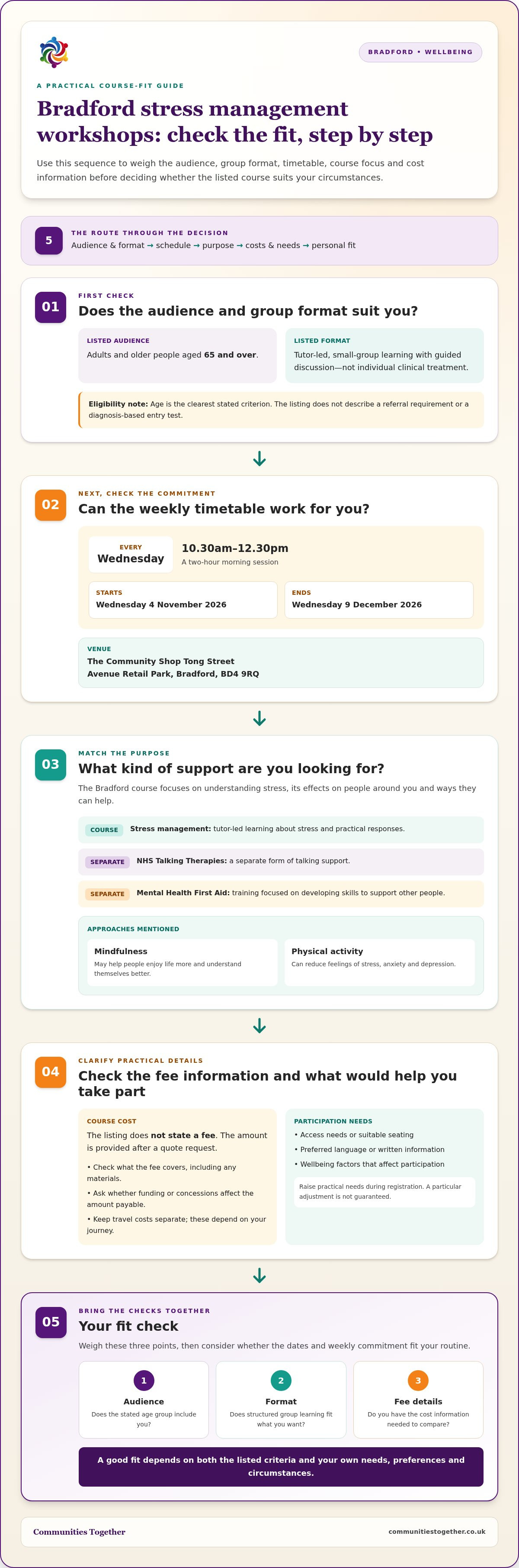
Bradford’s tutor-led stress management workshops run on Wednesdays from 10.30am to 12.30pm, from Wednesday 4 November 2026 to Wednesday 9 December 2026, at The Community Shop Tong Street, Avenue Retail Park, Bradford, BD4 9RQ. The course is listed for adults and older people aged 65 and over. These details offer a practical starting point for deciding whether the timetable and eligibility suit you.
Stress can affect daily routines and relationships, so learning practical ways to respond may help you and the people around you. This guide explains what to expect from stress management workshops in Bradford, who they are for and what to consider about costs. It also covers everyday wellbeing strategies, how stress can affect others and how to support someone experiencing it, helping you make an informed decision about taking part.
Table of Contents
Tutor-led small-group stress management course
A tutor-led group provides structured time to explore stress and practical responses. In Bradford, the listed course follows a weekly schedule at The Community Shop Tong Street.
Course options and providers
The Bradford option is a tutor-led, small-group course. NHS Talking Therapies are a separate form of support, while Mental Health First Aid courses train people to support others. Each serves a different purpose: consider whether you want to learn personal coping approaches, access talking support or develop skills to help someone else.
For a local course, check its audience and format before choosing. The Bradford course is listed for adults and older people aged 65 and over. Its group setting can provide guided discussion alongside tutor-led learning, whereas Mental Health First Aid focuses on supporting others rather than serving as the same type of stress-management course.
Schedules and locations
The Bradford course runs on Wednesdays from 10.30am to 12.30pm. It takes place at The Community Shop Tong Street, Avenue Retail Park, Bradford, BD4 9RQ. A two-hour morning session gives you a regular appointment for guided learning and group discussion.
Before planning your journey, note the venue address and session time together. Add the Wednesday timetable to your diary and allow time to reach Avenue Retail Park. A regular weekly slot can help you fit the course around work, caring responsibilities, study and other commitments.
Course dates and costs
The scheduled course runs from Wednesday 4 November 2026 to Wednesday 9 December 2026. Its Wednesday sessions fall within that date range, so use the start and end dates when considering whether you can attend throughout.
The course details do not state a fee. Costs can vary with the provider, funding arrangement and course format, including whether materials are provided. When comparing options, look at the stated fee, what it covers and whether concessions or funded places apply. These details determine what a participant pays.
Topics and techniques
Bradford stress management workshops cover understanding stress, its effects on people around you and ways they can help. Practical approaches may include mindfulness, which can help people enjoy life more and understand themselves better, and physical activity, which can reduce feelings of stress, anxiety and depression.
The course is listed for adults and older people aged 65 and over, rather than as a dedicated programme for workplace stress, students, carers or parents. Its listed focus is broader stress management; consider whether that group focus fits your needs. If you attend, note one everyday situation that feels stressful and consider how a technique discussed in class might fit into your routine.
Eligibility and cost
The Bradford course is listed for adults and older people aged 65 and over. It is tutor-led, so its format centres on learning and discussion in a group rather than individual clinical treatment.
For accessibility, language and wellbeing support, use registration to explain any practical needs, preferred language or adjustments that would help you take part. The course information identifies tutor-led group learning, while suitability also depends on whether the session format works for you.
Age is the clearest stated eligibility point: the course is listed for adults and people aged 65 and over. If you are considering it for someone else, first establish whether they are an adult or aged 65 and over, then consider whether they want to learn in a group setting. The listing does not describe a referral requirement or a diagnosis-based entry test.
Eligibility is only one part of deciding whether a course suits you. Consider your aim, such as learning everyday ways to respond to stress, and whether you feel comfortable discussing it in a group. Tutor-led sessions may suit people who value structured learning; someone seeking individual clinical support has a different need from someone attending a general learning course.
Course costs depend on the provider’s funding and delivery arrangements, including the format and any materials. The amount is provided after a quote request. When comparing fees, identify what the price covers and whether funding or concessions affect the amount payable. Separate the course fee from travel costs, which depend on your journey to the venue.
Before registering, list practical considerations such as access needs, your preferred learning language and any wellbeing factors that affect participation. This helps you explain what would make sessions manageable, such as written information or suitable seating. Raise these points during registration, but remember that a particular adjustment is not guaranteed.
To make a decision, weigh three points: the stated age group, the group-teaching format and the fee information available through registration. If they suit your needs, consider the course dates and whether the weekly commitment fits your routine. This separates eligibility from personal suitability, so your choice reflects both the stated criteria and your circumstances.
How stress affects people around you
Stress can affect conversations and shared routines, as well as how one person feels. Bradford’s course covers how stress affects people around participants and how they can help. This wider focus encourages participants to consider relationships at home, at work and in their community.
For example, work pressure may leave someone quieter at home or make everyday decisions harder to discuss. A partner, relative or friend might mistake the change for disinterest, while the person experiencing stress may struggle to explain what is happening. Naming the pressure and its effects can help both people talk more clearly about support.
Workplaces also involve relationships that can influence wellbeing. A stated 70% of employees say their manager influences their mental health as much as their partner. This figure highlights why communication with a manager can matter, particularly when workload or workplace expectations are part of someone’s stress.
Start a practical conversation with one specific example rather than a broad account of everything that feels difficult. Someone might say, “I’m finding it hard to switch off after late shifts,” then explain what support could help. The other person can listen, check they have understood and discuss a manageable next step.
With a partner or relative: describe one situation that feels stressful, such as difficulty balancing household tasks, and explain what would make that moment easier.
With a friend: agree on a practical form of support, such as listening without trying to solve the issue immediately.
With a manager: raise a specific work pressure and discuss which task or expectation needs attention first.
Support does not require having all the answers. A family member can ask what would be useful today, while a colleague can help identify a work issue to raise. Small, clear actions can reduce misunderstandings and encourage a caring response instead of assumptions.
The course’s focus on how others can help also encourages participants to consider their own support network. Identify someone you trust, choose a suitable time to talk and explain what kind of response would help. For example, you may want company on a walk rather than advice about work.
Stress affects relationships in different ways, so listening and discussing specific examples is more useful than guessing what someone needs. Participants can reflect on these effects, consider what support they value and identify a realistic conversation to have after a session.
Registration and contact details
Start with the course listing, find its registration route and follow the instructions provided. The listing gives the course name, weekly format and eligibility, helping you decide whether to proceed. Keep these details together as you prepare to register, so you can refer to the same information throughout.
Before submitting an enquiry or registration, write down what you need to clarify. For example, note whether you meet the listed age criteria, can attend the scheduled sessions and can reach the venue. A short, organised list makes it easier to explain your circumstances and understand the next step.
Use a simple preparation checklist:
Course fit: note that the course is for adults and older people aged 65 and over.
Attendance: consider whether the Wednesday sessions fit your regular commitments.
Access: record any practical requirements that would support your participation.
Learning needs: identify your preferred language and any information format that helps you follow group sessions.
Cost: note any fee details shown with the course, alongside questions about what the fee covers.
Someone balancing work and caring responsibilities, for instance, could compare the course timetable with their weekly routine before registering. Another participant might prioritise access arrangements or language needs. These examples help you assess practical suitability, rather than treating registration as a form to complete without considering the experience.
If the registration route invites questions, keep your enquiry focused. State which course you mean, what you need clarified and any relevant practical details. For example: “I’m interested in the Bradford stress management course and would like to discuss access needs.” This gives the recipient a clear subject and a useful starting point.
Contact details should come from the course’s own registration information, so use the named route provided with its listing. Keep a record of the action you take, such as the date you submit a form or the details of an enquiry. This simple step helps you follow the process without relying on memory.
After registering, keep the course information together, including any response, attendance instructions and notes about access needs. If you are helping a relative or friend, involve them in the decision and, where possible, let them explain their preferences directly. Keep the process centred on the participant’s circumstances.
Registration is most useful when it follows a considered choice: the course suits the participant’s age group, the sessions fit their routine and practical needs have been identified. Preparing these points in advance makes it easier to move from interest to a purposeful next step.
Which organisations offer stress management workshops in Bradford?
Bradford’s listed option is a tutor-led stress management course at The Community Shop Tong Street. Its scheduled dates run from Wednesday 4 November 2026 to Wednesday 9 December 2026. The available course details identify the venue and format, rather than naming a separate organisation delivering it.
Different kinds of support serve different purposes. NHS Talking Therapies are a separate option for people seeking talking support, while Mental Health First Aid courses teach people how to support others. A tutor-led stress management course focuses on learning about stress in a group. These options are not interchangeable, so begin by deciding what kind of support you need.
For the Bradford course, use the listing’s eligibility and schedule to assess whether it suits you. It is for adults and older people aged 65 and over, with sessions on Wednesdays from 10.30am to 12.30pm. The venue is The Community Shop Tong Street, Avenue Retail Park, Bradford, BD4 9RQ. These details help you compare the practical fit without assuming every local programme has the same format.
When weighing options, consider their purpose, audience and format:
Personal learning: a tutor-led course offers structured group learning about stress management.
Talking support: NHS Talking Therapies are a separate support route; consider whether talking support matches your needs.
Supporting someone else: Mental Health First Aid training has a different focus from attending a course for personal stress management.
These distinctions matter for workplace stress, study pressures, caring responsibilities or parenting demands. The Bradford course is listed for adults and older people aged 65 and over, but its details do not identify separate programmes for those specific circumstances. Someone seeking tools for personal stress can consider the general course; someone seeking skills to support colleagues may be looking for a different learning purpose, while an individual looking for focused personal growth and mindset support might benefit from an empowerment life coach for women.
Before choosing, match the course information to your main aim. Decide whether you want guided learning, talking support or training to help another person. Then compare the stated audience, venue, session times and dates. This keeps your decision grounded in the actual format rather than assumptions based on an organisation’s name.
For the Bradford course, use its listing as the reference point for the venue and scheduled sessions. If your priority is broader community wellbeing, explore local community support.
Communities Together: Community Engagement Programmes
Communities Together offers Community Engagement Programmes for people and groups seeking stronger local connections and participation. If you are looking beyond an individual stress management course, its Wellbeing and Resilience Workshops offer a community-focused way to explore wellbeing and resilience together.
Communities Together also runs South Asian Arts and Heritage Activities and Heritage and Cultural Preservation projects, supporting cultural connection alongside community engagement. These activities may suit groups whose wider priorities include shared identity, participation and wellbeing.
If you’d like to explore how Communities Together’s programmes relate to your community’s needs, visit communitiestogether.co.uk.
Take a considered next step for your wellbeing
Choosing among stress management workshops in Bradford is a personal decision shaped by the support and learning environment you want. Start by identifying what you hope to change, then consider whether individual learning or a community-based approach is more relevant.
If you are interested in wellbeing as part of stronger community connection, Communities Together offers Community Engagement Programmes, South Asian Arts and Heritage Activities, and Wellbeing and Resilience Workshops. These provide a community-focused way to build participation, connection and resilience alongside your wellbeing interests.
You do not need to have every next step mapped out. A clear sense of what matters to you can guide a thoughtful conversation and help you decide where to begin.
Taking time to explore the right kind of support is a positive step towards greater understanding and wellbeing.
Frequently Asked Questions
What stress management workshops are available in Bradford, UK?
Bradford’s listed option is a tutor-led, small-group course for adults and older people aged 65 and over. The stress management workshops Bradford residents can consider have different purposes: NHS Talking Therapies offer a separate talking-support route, while Mental Health First Aid courses focus on supporting others. Start by deciding whether you want personal learning, talking support or skills to help someone else.
What dates and times are upcoming stress management workshops in Bradford?
The listed Bradford course is scheduled for Wednesdays, 10.30am to 12.30pm, from Wednesday 4 November 2026 to Wednesday 9 December 2026. Its morning timetable can help you plan around work, caring duties or other commitments. For example, compare the session time with your weekly calendar and consider whether you can attend throughout the scheduled course period.
How much do Bradford stress management workshops cost, and are any free?
The fee, and whether a free place is available, depends on the provider’s funding arrangements and course format. There is no single cost for every option in Bradford. For budgeting, separate the course fee from personal expenses such as travel. Review the specific course’s fee information and what it covers, then consider whether it fits your circumstances.
Where are the workshops held, and are online or hybrid options available?
The listed Bradford course is held at The Community Shop Tong Street, Avenue Retail Park, Bradford, BD4 9RQ. Its described format is an in-person group session at that venue. Online or hybrid delivery is a separate format, so don’t assume it applies to this course. If remote access matters, include delivery method in your comparison and planning.
Who can attend, and are workshops open to the public or limited to specific groups?
The Bradford course is listed for adults and older people aged 65 and over. That stated audience is a helpful starting point when considering whether the course suits you. It’s described as group learning, rather than a programme specifically for students, carers, parents or employees. If you’re considering it for someone else, include their preferences and comfort with group participation in the decision.
How do I book a place, and do I need a referral?
Begin with the course’s registration route and have your availability and access needs ready. The stated age group is the eligibility criterion; a referral is not listed as a course requirement. Write down language preferences or practical requirements before registering. This helps you organise the information you need and plan around your circumstances.
How do Bradford workshops compare with NHS or other local stress support services?
A tutor-led course provides structured group learning, while NHS Talking Therapies are a separate talking-support option. Mental Health First Aid courses focus on learning to support others. Choose stress management workshops in Bradford according to your aim: personal learning, talking support or skills to help someone else. Communities Together also offers non-clinical wellbeing and resilience workshops, alongside community programmes in Bradford, Huddersfield, Halifax, Leeds and Wakefield.
What accessibility, language and wellbeing support do local workshops provide?
During registration, explain any access needs, preferred learning language or wellbeing factors that affect your participation. You can ask about practical adjustments, such as written information or suitable seating, though these are not guaranteed.



Comments