
Loneliness in UK young adults: who is affected and why
Updated: 3d
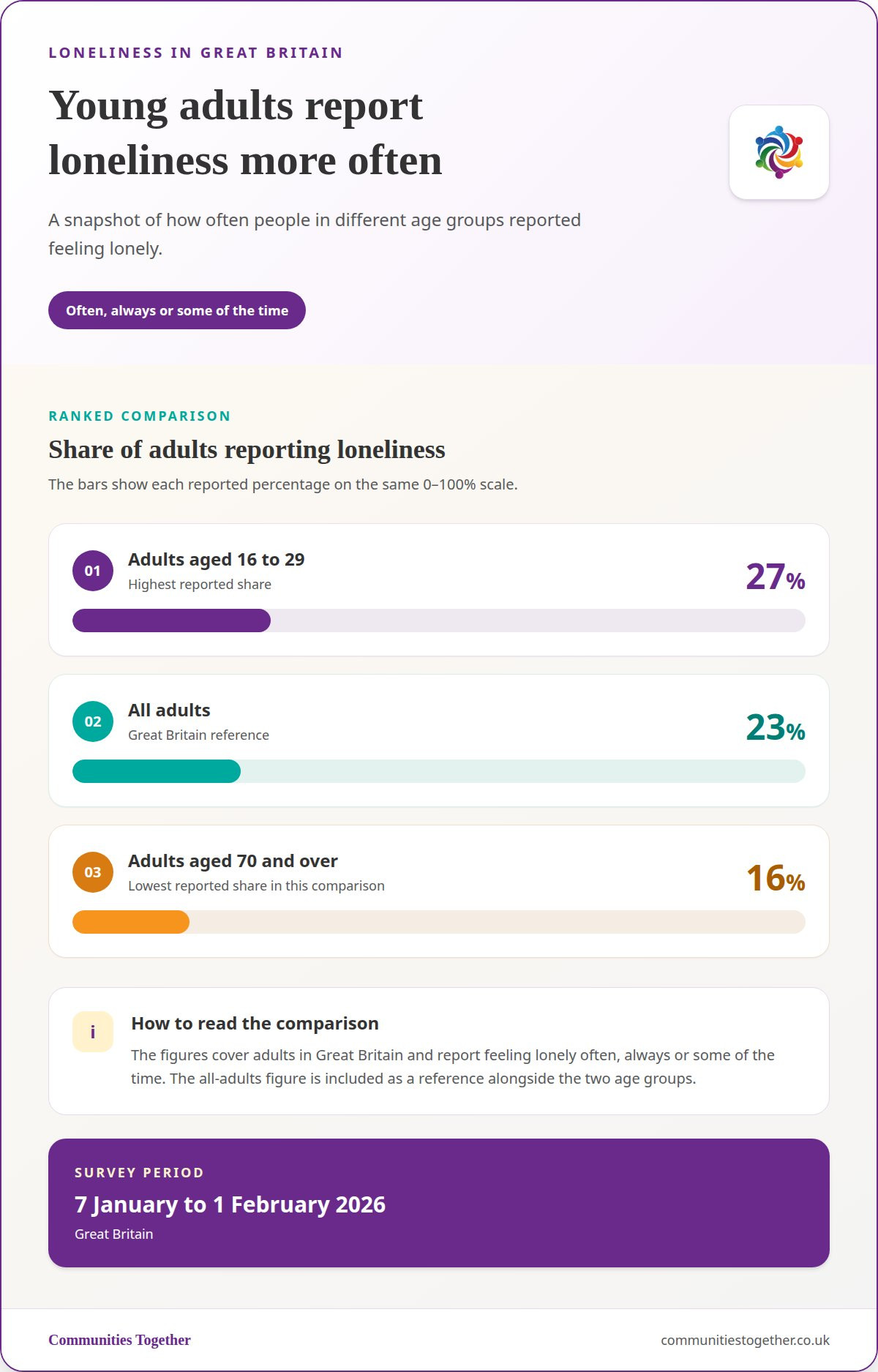
In Great Britain, 27% of adults aged 16 to 29 reported feeling lonely often, always or some of the time between 7 January and 1 February 2026, compared with 16% of adults aged 70 and over. Loneliness in young adults in the UK is therefore an important issue to understand, not an experience that affects only older people.
Friendships, study, work and living arrangements can all affect how connected someone feels. Online contact does not always provide the sense of belonging they need. This article looks at who may be more likely to experience loneliness, how access to support can differ, and why leaving education or youth services may reduce opportunities to connect. It also explores social media and how group activities, community engagement and wellbeing support can help young adults build meaningful connections.
Table of Contents
What is the current state of loneliness in children and young people?
Loneliness affects different age groups, but recent figures show young adults report it more often than older people. Comparing rates helps explain who may need stronger social networks and accessible support.
Young adults compared with older people
Loneliness is the feeling of lacking meaningful connection, even when other people are nearby. In Great Britain, 27% of adults aged 16 to 29 reported feeling lonely often, always or some of the time from 7 January to 1 February 2026. Loneliness can affect people across different age groups. This comparison matters because it challenges the assumption that loneliness is mainly an issue for older people.
Across all adults in Great Britain, 23% reported loneliness often, always or some of the time during the same period. Young adults’ higher rate points to differences between age groups, not an experience shared equally by everyone. It also makes life stage relevant: changing friendships, work and education can affect how often people meet and maintain close ties.
Loneliness rates among young adults in the UK
Rates of loneliness describe how often people report feeling disconnected within a particular age range and survey period. In February 2025, more than 10% of UK under-30s said they felt lonely most or all of the time. A separate Great Britain estimate found 27% of people aged 16 to 29 felt lonely often, always or some of the time in early 2026.
These figures measure different frequencies over different periods, so they are not a direct trend comparison. Together, they show why one headline rate may not capture every young person’s experience. The broader measure includes occasional loneliness, while the February figure describes feeling lonely most or all of the time.
Loneliness rates among adults aged 16 to 24
Adults aged 16 to 24 sit within the wider young-adult group, but their reported experiences have varied across surveys. In England, 10% of adults aged 16 to 24 said they felt lonely often or always between October 2023 and March 2024. In a 2018 UK measure, 9.8% of people aged 16 to 24 reported often feeling lonely.
Those figures use different dates and should be read in context rather than as proof of a clear rise or fall. Children and younger teenagers also appear in wider evidence: in England, young people aged 11 to 24 reporting no close friends increased from one in 100 in 2014 to one in 20 in 2023-25. Among 16- to 21-year-olds, at least three close friends fell from 85% in 2012-14 to 72% in 2023-25.
Adults aged 25 to 34 also report frequent loneliness. In England, 9% said they felt lonely often or always between October 2023 and March 2024. Comparing this with the 10% figure for adults aged 16 to 24 offers a useful snapshot, but both figures describe England and a specific period. They do not capture every difference in people’s friendships, circumstances or access to social networks.
3.2 How does access to support networks vary by subgroups?
Support networks can shape how people manage difficult feelings, but access differs between groups. In England, loneliness rates and measures of social support underline why connection and mental health support both matter.
Social connections and emotional health
Social connection means having people available for conversation, company and emotional support. It matters because feeling lonely is associated with future mental health problems, particularly depression. A review of scientific literature found this association could extend for up to 9 years. The finding describes an association, not proof that loneliness alone causes mental health problems.
An estimated 60% of people experiencing chronic loneliness experience mental distress, compared with 15% of people who are not chronically lonely. These figures show a marked difference between the groups, while not establishing the direction of the relationship. Mental distress can make maintaining relationships harder, and loneliness can accompany distress. Both experiences may therefore require attention.
Gender differences also appear in England’s loneliness figures. Between October 2023 and March 2024, 8% of female adults reported feeling lonely often or always, compared with 6% of male adults. These figures measure reported loneliness, not mental health diagnoses, and they cover adults rather than young adults alone. They indicate that experiences vary across groups, rather than identifying a single explanation.
Access to mental health support
Access to mental health support means being able to reach appropriate help when emotional difficulties arise. Social support is one part of that picture: in England, 95% of adults had at least one person they could count on to listen when they needed to talk between October 2023 and March 2024. That measure captures a potential source of connection, not access to clinical care.
Practical access to company can also differ by disability. In England, 87% of disabled adults said they could call on people for company or socialising, compared with 94% of non-disabled adults during the same period. For someone who finds crowded or inaccessible settings difficult, a welcoming group or one-to-one conversation may offer a more workable route to connection.
Chronic loneliness is also associated with physical health concerns, so sustained isolation deserves attention alongside emotional wellbeing. Support may include trusted relationships, accessible community activities and mental health care suited to the person’s needs. For those seeking professional guidance, online platforms such as TheraConnect connect individuals with licensed therapists and wellness professionals. Community activities can create regular opportunities to connect, but they do not replace clinical support when treatment is needed. The right support depends on the person’s circumstances.
Does social media have a role?
Young adults may feel lonely when they move, change routines, work remotely or lack close relationships. Social media can help maintain contact, but it may not provide the shared time and support they are looking for.
These factors can overlap: moving may disrupt friendship networks, while remote work can reduce everyday conversations. A national survey found that 35% of young people felt lonely often or most of the time despite spending three hours on social media in April and May 2020.
Social media and loneliness
Social media makes it possible to communicate and follow friends’ lives without meeting in person. Digital contact can help maintain relationships, but screen time alone does not ensure that someone feels understood or included.
In the UK, the average 18-to-24-year-old spent six hours and 20 minutes online each day this year. That figure covers all online activity, not social media alone, and doesn’t show whether users felt connected. For example, messaging a friend may offer genuine support, while scrolling through updates can leave someone feeling apart from the group.
Moving away and losing social connections
Moving away can mean leaving familiar routines, shared spaces and nearby friends behind. New surroundings may not immediately provide the regular contact that helped sustain earlier relationships.
Social networks tend to drop by nearly half after age 25, making this transition relevant to young adults building new routines. A person who moves for work or study may still message old friends, but distance can make spontaneous meet-ups harder. Remote work can also limit casual conversation: in the first quarter of 2025, 28% of UK residents aged 16 to 29 worked from home at least some of the time.
Social media and friendship expectations
Friendship expectations are beliefs about how close friends should communicate and spend time together. Social media can affect these expectations because frequent posts and quick messages may make other people’s social lives seem constant.
For example, seeing photos of a group outing may prompt someone to wonder why they were not included, even though a post shows only one moment. Online contact can also create pressure to reply quickly or appear cheerful. A better measure of connection is whether someone can share concerns and spend meaningful time with friends, not how often people post or react.
Loneliness and social isolation
Loneliness is the distress someone feels when their relationships lack the closeness they want. Social isolation means having limited social contact or networks. The distinction matters: someone can feel lonely among other people, or have few contacts without feeling lonely.
For instance, someone working from home may have limited daily conversation yet feel content with close relationships. Another person might attend regular gatherings and still feel excluded. A 2023/24 measure in England found 10% of adults reported high levels of indirect loneliness, illustrating that social experience involves more than counting interactions. Online messaging, shared activities and one-to-one conversations can each contribute differently to connection.
Regular, welcoming opportunities to meet can help people build contact beyond their screens. Explore community connection opportunities as one way to find shared activities and strengthen local ties.
Group activities and friendship initiatives
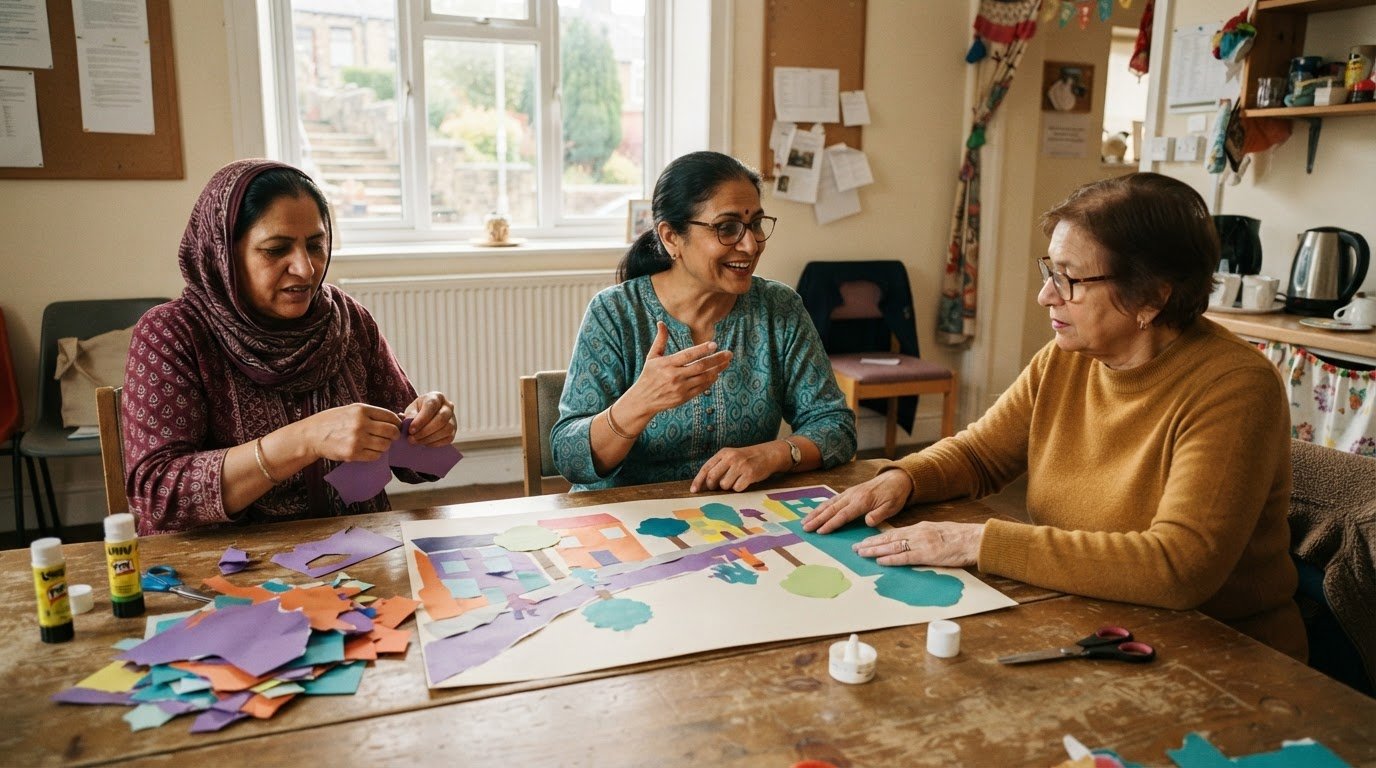
Group activities offer regular opportunities to meet through a shared interest, task or cultural experience. A weekly arts session, for example, gives people something to do together, which can make conversation easier than an unstructured introduction. Returning regularly also gives familiar faces time to become acquaintances and potentially friends, without expecting instant closeness.
Cost can shape whether young people join in. In a UK Youth survey, 36% of young people reported feeling lonelier because they had cut back on social activities to save money. Free or affordable community activities may therefore reduce a practical barrier, while local groups can make participation easier through accessible venues and welcoming formats.
A useful friendship initiative offers more than a one-off gathering. A regular craft group, walking meet-up or shared learning session gives people a predictable reason to return. Organisers can introduce participants, invite newcomers into a simple activity and allow for conversation at different comfort levels. This helps people take part without needing to arrive with an existing friendship group.
Shared creative activities can bring generations together, as well as people of similar ages. South Asian arts and heritage activities, for instance, can connect participants through music, storytelling or cultural practices and create opportunities to exchange knowledge. A shared focus gives people a starting point for conversation and can support belonging across age groups, backgrounds and experience.
Access matters as much as the activity itself. Groups can consider transport, timing, language, physical access and whether newcomers know what to expect. A clear welcome and a named facilitator, for example, can help someone arriving alone understand how to join in. These details affect whether a group feels open to different people, not just those already confident in social settings.
There is also a wider community context. Local authority spending on youth services in England fell by 73% between 2010/11 and 2023/24. This change can affect the structured places where young people meet, learn and form networks. Community-led initiatives may help create additional opportunities, although a single activity cannot replace the wider range of sustained support young people may need.
To make a group welcoming, organisers can use a few practical measures:
Choose a shared activity, such as art, cooking or heritage learning.
Set a regular schedule, so participants know when they can return.
Offer a clear welcome and an easy first task for newcomers.
Build in informal time for conversation, without making it compulsory.
These approaches make participation more predictable and give friendships time to develop. Each person’s route into a group depends on their interests, confidence, access and available time. A recurring activity, such as a heritage workshop, can offer a manageable first step and a reason to reconnect with the same people.
Support for young people experiencing loneliness
Support works best when it responds to a young person’s circumstances, rather than treating loneliness as a personal failing. Start by considering whether they need more opportunities to connect, someone trusted to talk to, or support for mental health concerns. These needs can overlap, but they are not the same.
For example, a community group can offer routine contact and shared activities, while a link worker can help someone identify suitable sources of support. One programme plans for a link worker to meet each young person for six to eight sessions. This allows time to discuss what matters, consider options and build a connection gradually, rather than relying on a single conversation.
Young people may also need support that fits their age and changing circumstances. After age 21, many lose access to the structured social settings provided by education or youth services. UK Youth’s head of policy argues that youth work should serve people up to the age of 25. This highlights a practical gap: transitions into work, further study or independent living can change where young people find routine support.
Programme design can connect individual support with wider community settings. A four-year social-prescribing programme plans to identify children aged nine to 13 who feel lonely or isolated, then compare outcomes over the following year. Its pilot planned to recruit 12 primary and secondary schools, with an aim to expand to 30 schools across the UK the year after the pilot began. These figures concern children, but show how schools can help identify isolation and connect young people with support.
The pandemic also showed how disrupted contact can affect relationships. In survey findings on young people during COVID-19 restrictions, 76% said being unable to see friends had a negative impact, while 26% said their friendships had worsened. For someone who still feels lonely after social routines return, support may need to rebuild regular contact, confidence and trust over time.
Practical support can take several forms, depending on what the young person says feels manageable:
A link worker conversation to explore personal priorities and possible support.
A welcoming group activity that provides shared purpose and repeated contact.
A trusted adult or peer who can listen and help maintain connection.
Clinical mental health support when distress needs specialist assessment or treatment.
Statistics describe patterns, not an individual’s full experience. Someone may feel lonely despite having friends, while another person may have limited contact without feeling lonely. A supportive response starts with listening, then matches the next step to that person’s needs, preferences and circumstances.
Communities Together
Communities Together helps strengthen local connection through community engagement, shared activities and wellbeing support. If loneliness is making it harder to feel part of a community, these approaches can create welcoming opportunities to meet others, build confidence and take part at a comfortable pace.
Communities Together’s Community Engagement Programmes, South Asian Arts and Heritage Activities, Wellbeing and Resilience Workshops, and heritage projects bring people together around shared interests and experiences. They support social connection and community wellbeing, but are not clinical mental health treatment.
To explore how community-based support could help, contact Communities Together.
Make connection part of your next step
Understanding loneliness among young adults in the UK can shift attention from self-blame towards the conditions that support belonging. The next step does not need to be a sweeping change. Consider what makes connection feel genuine to you: being listened to, sharing an interest or having regular contact with someone you trust. This can help you choose a manageable way forward instead of judging progress by how busy your social calendar looks.
For community groups and organisations, the same principle applies: create welcoming opportunities for people to return, take part and become familiar with one another at their own pace. Lasting connection grows through taking part together, and each person’s route towards it can look different.
A small, considered step can open the way to stronger connection. You deserve to feel that you belong.
Frequently Asked Questions
Who was more likely to experience loneliness?
Young adults were more likely than older adults to report frequent loneliness in Great Britain. In a survey conducted from 7 January to 1 February 2026, 27% of adults aged 16 to 29 reported feeling lonely often, always or some of the time, compared with 16% of adults aged 70 and over. Circumstances also matter: in England, disabled adults and adults whose gender identity differed from their sex registered at birth reported higher rates.
Is the pandemic solely to blame for this?
No. The pandemic disrupted opportunities to meet friends, but loneliness is also shaped by changes in education, work, housing and social networks. During COVID-19 restrictions, 76% of young people said being unable to see friends had a negative impact. That finding shows the importance of contact, but it doesn’t establish the pandemic as the sole cause. Transitions such as leaving education or moving for work can also alter daily opportunities to connect.
How common is loneliness among young adults in the UK?
It depends on the age range, survey period and how often loneliness is measured. In February 2025, more than 10% of UK under-30s said they felt lonely most or all of the time. In a separate 2019 survey, 88% of people aged 18 to 24 experienced loneliness to some degree, while 24% often experienced it. These figures describe different measures, so they shouldn’t be treated as direct comparisons.
Which age groups and regions in the UK report the highest loneliness?
Recent Great Britain figures show adults aged 16 to 29 reported frequent loneliness more often than adults aged 70 and over. Available England figures also show differences by area: between October 2023 and March 2024, 7% of adults in urban areas reported feeling lonely often or always, compared with 5% in rural areas. These figures compare broad area types, not individual towns or every UK nation.
How has loneliness among young adults changed in the UK in recent years?
Different surveys suggest loneliness remains a concern, but their measures and age ranges vary. In a 2019 survey, 24% of people aged 18 to 24 said they often experienced loneliness. In England, 10% of adults aged 16 to 24 reported feeling lonely often or always between October 2023 and March 2024. These results don’t provide a like-for-like trend, so they can’t establish a precise rise or fall.
What are the effects of loneliness on young adults’ mental and physical health?
Loneliness is associated with mental distress and future mental health problems, particularly depression. Among lonely young people, 62% said loneliness made them lose confidence in themselves. Chronic loneliness has also been linked with physical health risks, including cardiovascular disease and dementia later in life. These are population-level associations, not predictions about an individual. If loneliness is affecting daily life or wellbeing, support from a trusted person or a qualified health professional can be a useful next step.
Which UK groups of young adults are most at risk of loneliness?
Risk can be higher where social connection is harder to access, although some available statistics cover adults of all ages rather than young adults alone. In England, 15% of disabled adults reported feeling lonely often or always, compared with 3% of non-disabled adults. The rate was 19% for adults whose gender identity differed from their sex registered at birth, compared with 7% for others. These figures highlight unequal experiences, not fixed outcomes.
What free UK support and helplines are available for young adults experiencing loneliness?
Support may include trusted people, community activities and social-prescribing services, which connect people with local sources of support. More than one million people of all ages were referred to NHS social-prescribing services in 2023. This figure doesn’t identify helplines or establish whether a particular activity is free. For urgent or serious mental health concerns, seek help from an appropriate clinical service; community programmes support connection but don’t provide clinical treatment.
Comments