
Emotional resilience workshops for Bradford participants
Emotional resilience workshops in Bradford can give participants a structured way to practise responding to pressure, change and setbacks while building confidence and supportive connections. In Bradford District, some programmes are designed for parents, carers, grandparents or young people, so eligibility depends on the intended audience.
Resilience develops over time. A workshop can offer space to reflect, learn practical approaches and connect with others facing similar challenges. The best fit depends on who the sessions are for and what participants want to work on.
This article explains how workshops can support emotional resilience, which Bradford-based participants may be eligible, and the kinds of topics and activities sessions can include. It also outlines how to consider a workshop’s purpose and approach, so you can understand what the experience may offer and whether it aligns with your needs.
Table of Contents
Building resilience in Bradford
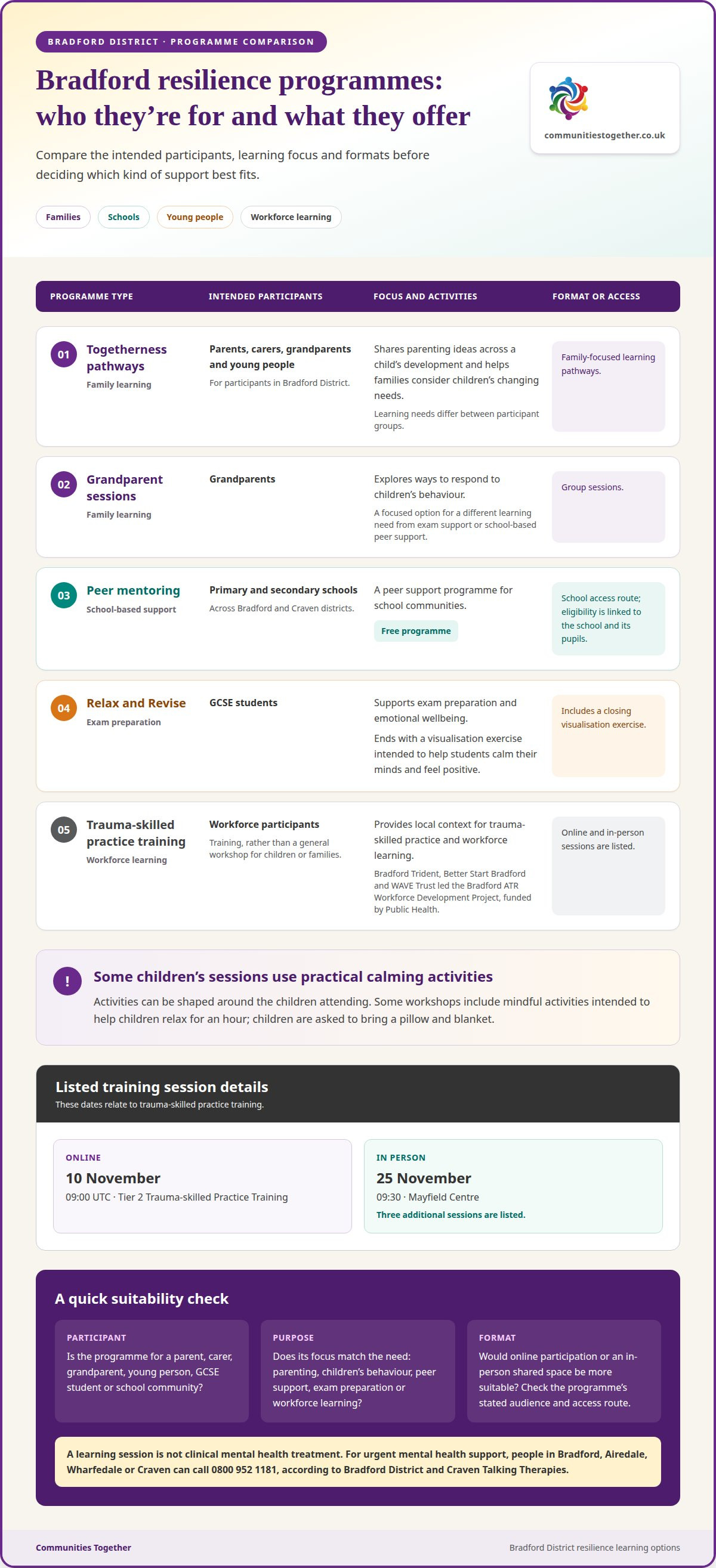
Bradford programmes address resilience through family learning, school activities and practical wellbeing sessions. Choose according to the participant’s age, role and learning needs.
Bradford workshop options
Bradford has different options for children, young people, parents, carers and grandparents. Togetherness pathways share parenting ideas across a child’s development, while grandparent sessions explore responses to children’s behaviour. Schools can access peer mentoring, and Relax and Revise is designed for GCSE students.
Online learning can suit people who need to join remotely; in-person sessions provide a shared space for group activities. A listed online Tier 2 Trauma-skilled Practice Training session runs at 09:00 UTC, whilst an in-person session is scheduled at Mayfield Centre. To book, identify the intended participant group, choose a suitable programme, then follow the organiser’s registration instructions.
Workshop providers
Bradford Trident, Better Start Bradford and WAVE Trust led the Bradford ATR Workforce Development Project, funded by Public Health. The project provides local context for trauma-skilled practice and workforce learning. Other programmes serve distinct audiences: Togetherness learning is aimed at parents, carers, grandparents and young people in Bradford District.
For school-based support, a free peer mentoring programme is available to primary and secondary schools across Bradford and Craven districts. Some workshops are led by confidence coaches who are Youth Mental Health First Aiders. When comparing programmes, consider the intended group, the facilitator’s role and whether sessions focus on families, pupils or professional practice.
Topics and activities
Workshop topics can include parenting approaches, children’s behaviour, exam preparation and emotional wellbeing. Sessions designed around the children in each group can make activities relevant to participants. Relax and Revise supports GCSE students, while Togetherness pathways help families consider children’s changing needs.
Some children’s workshops include mindful activities intended to help participants relax for an hour. Children are asked to bring a pillow and blanket. Relax and Revise ends with a visualisation exercise intended to help students calm their minds and feel positive. These examples show how activities can match a programme’s aims.
Dates and venues
Upcoming listings include an online Tier 2 Trauma-skilled Practice Training session on 10 November at 09:00 UTC. An in-person session is scheduled for 25 November at 09:30 at Mayfield Centre, with three additional sessions listed. These are trauma-skilled practice training sessions, rather than general workshops for children or families.
Match the date and setting to the participant’s role: online training is listed for remote attendance, while Mayfield Centre is the named in-person venue. For other Bradford workshops, booking depends on the programme and intended group. People in Bradford, Airedale, Wharfedale or Craven can call 0800 952 1181 for urgent mental health support, according to Bradford District and Craven Talking Therapies.
Eligibility for Bradford-based participants
Eligibility depends on the programme’s intended audience and the participant’s connection to Bradford District. Check whether sessions are designed for an individual, a family or a school community.
Participant eligibility
Togetherness learning is aimed at parents, carers, grandparents and young people in Bradford District. Each group has different learning needs, so a parent-focused pathway may not suit a young person seeking exam support. School access follows a separate route: free peer mentoring is available to primary and secondary schools across Bradford and Craven districts.
Relax and Revise is designed for GCSE students. Before choosing, identify the participant’s role and the programme’s intended audience. School-based support may be accessed through a school, while a family pathway may focus on parents, carers or grandparents.
Checking workshop suitability
Match the workshop’s purpose to the participant’s immediate learning goal. A grandparent seeking ideas for responding to children’s behaviour, for example, has a different focus from a GCSE student preparing for exams. Consider whether a session is intended for children, adults, families or school communities.
If a workshop does not fit, choose a programme with a closer match to the participant and their needs. A learning session is not clinical mental health treatment. If the need is urgent, people in Bradford, Airedale, Wharfedale or Craven can call 0800 952 1181 for urgent mental health support, according to Bradford District and Craven Talking Therapies.
Free and NHS-funded options
A free peer mentoring programme is available to primary and secondary schools across Bradford and Craven districts. This offers eligible schools a no-cost route to peer support, not a general workshop open to every resident. Eligibility is linked to the school and its pupils.
For a free option, start by identifying whether the participant attends a primary or secondary school covered by the programme. NHS funding should not be assumed from the word “resilience” alone; check the stated purpose and intended audience of each option. Community-based learning approaches can also help readers consider wellbeing alongside shared participation.
What emotional resilience workshops are available in Bradford, UK?
Bradford has workshops and learning programmes for families, school communities and young people. Formats differ, so choose according to the participant group and practical learning aim.
Family learning pathways
Togetherness pathways support parents and carers through stages of a child’s development, offering parenting advice and ideas to consider in daily family life. A related pathway for grandparents focuses on responding to children’s behaviour and helping them thrive.
These options differ from workshops for pupils. A parent seeking ideas about a child’s changing needs may find a family pathway more relevant than an exam-focused session. Grandparents can look for learning centred on their role and relationships with children. The intended audience is a useful starting point.
School and GCSE support
Schools in Bradford and Craven can access a free peer mentoring programme for primary and secondary pupils. This school-based option is not a general drop-in workshop for every resident. Schools can consider whether peer mentoring suits pupils who would benefit from support in their school community.
Relax and Revise is designed for students studying for their GCSEs. Confidence coaches who are Youth Mental Health First Aiders lead the workshops. Its focus on GCSE students distinguishes it from family pathways and school-wide peer mentoring. Students and families can compare the intended audience with the support sought.
How sessions are structured
Workshop sessions are designed around the children in each group, so activities can reflect the participants rather than follow one identical format for everyone. Some children’s sessions include mindful activities intended to help them relax for an hour.
Children attending these sessions are asked to bring a pillow and blanket for the relaxation activity. Relax and Revise sessions finish with a visualisation exercise intended to help students calm their minds and feel positive. These examples show how activities can vary by programme and age group.
Choosing a suitable format
For family learning, start with the participant’s role: parent, carer or grandparent. Then consider whether the aim relates to child development, behaviour or exam preparation. A young person studying for GCSEs may find the named revision workshop more relevant than a grandparent pathway.
For a school, distinguish peer mentoring from a workshop designed for GCSE students. Year groups and pupils’ learning aims can help identify a suitable route. These emotional resilience workshops in Bradford serve different groups, so matching a programme to its intended participants is a practical first step.
Which Bradford organisations run emotional resilience workshops?
Bradford’s resilience programmes include community learning and workforce development. The organisations involved have different roles, so distinguish project leadership from a workshop’s intended audience.
Bradford ATR Workforce Development Project
Bradford Trident, Better Start Bradford and WAVE Trust led the Bradford ATR Workforce Development Project, funded by Public Health. This named local partnership is connected with workforce development, rather than a public workshop designed directly for families or young people.
That distinction matters when comparing organisations. Project leadership identifies those involved in developing workforce practice; it does not mean every partner runs each local workshop. Consider whether you need professional learning, school-based support or a session for families. The organisation’s role helps clarify the route.
Organisations and programme roles
Bradford Trident, Better Start Bradford and WAVE Trust are the named partners in the workforce project, with funding from Public Health. These details identify the project’s leadership and support; they do not establish one universal provider for every resilience activity in Bradford.
Other local programmes serve different groups. School peer mentoring, for example, is available across Bradford and Craven districts, while family learning is directed towards parents, carers, grandparents and young people in Bradford District. Compare these programmes by audience and purpose rather than assuming they share a delivery organisation.
How to identify the right organisation
Start with the participant. A school seeking peer mentoring has a different route from a family looking for parenting learning. A GCSE student needs a programme designed for exam-year support. Matching the participant to the programme helps distinguish workforce training from community-facing sessions.
Next, consider the organisation’s stated role and the programme’s audience. The Bradford ATR Workforce Development Project names its three leaders and Public Health funding. A workshop may instead identify its facilitator, such as a confidence coach who is a Youth Mental Health First Aider. These roles describe different parts of local provision.
Understanding partnership delivery
Bradford’s named workforce project shows how partners can work together around a shared learning aim. For residents, the practical question is whether a programme is intended for their group and addresses their learning goal. Schools can look for school-based offers; families can seek a pathway designed for their role.
Use the organisation’s name, programme title and intended participants to compare options. Bradford Trident, Better Start Bradford and WAVE Trust led a specific workforce development project, while other local programmes address families, pupils or young people. This helps distinguish related resilience work without treating every Bradford organisation as interchangeable.
What topics and activities do Bradford resilience workshops cover?
Bradford sessions connect emotional resilience with family life, school experiences and practical wellbeing. Activities vary by audience: children’s sessions are shaped around each group, while GCSE support takes a distinct approach.
For parents and carers, Togetherness pathways cover stages of a child’s development and offer parenting advice and ideas to consider alongside family experiences. Grandparent pathways address children’s behaviour and ways to help them thrive. The participant’s relationship with the child can help identify which learning is relevant.
Some workshops for children use mindful activities intended to support relaxation for an hour. Children are asked to bring a pillow and blanket for this activity. This practical detail helps families prepare and shows that the session includes a dedicated relaxation element.
Relax and Revise is designed for students studying for their GCSEs. Its closing visualisation exercise is intended to help students calm their minds and feel positive. This gives the session a different emphasis from family learning, with a specific closing activity for students.
Sessions designed around the children in each group can adapt activities to those participants. Family learning may focus on child development or behaviour, while GCSE students take part in a visualisation exercise as a specific closing activity. The intended group and session purpose help clarify what participants will do.
Bradford’s programme range also includes trauma-skilled practice training. Bradford Trident, Better Start Bradford and WAVE Trust led the Bradford ATR Workforce Development Project, funded by Public Health. This workforce development is distinct from child-focused mindful activities or GCSE revision.
To compare activities, start with the participant’s role and the workshop’s stated purpose. A grandparent may want ideas about children’s behaviour, while a GCSE student may value a calming visualisation exercise. A parent may prefer learning connected with stages of child development. These distinctions make programme descriptions more useful than a broad resilience label alone.
Before attending a children’s relaxation activity, note the request to bring a pillow and blanket. For a GCSE session, consider whether the visualisation exercise aligns with the student’s learning needs. For family pathways, identify whether the content is intended for parents, carers or grandparents. These checks help participants arrive prepared and choose relevant learning.
Communities Together: Community Engagement Programmes
Communities Together delivers Community Engagement Programmes for groups seeking to strengthen participation, connection and local social cohesion. Its Wellbeing and Resilience Workshops support communities through shared learning, while South Asian Arts and Heritage Activities and Heritage and Cultural Preservation projects can foster cultural connection and continuity in Huddersfield, Halifax, Leeds, Bradford and Wakefield.
Consider this community-based approach when your aim extends beyond individual skills to relationships, shared experience and stronger local networks. Communities Together’s programmes offer a relevant next step for groups in Huddersfield, Halifax, Leeds, Bradford and Wakefield exploring how wellbeing and community engagement can work together.
To discuss community engagement and resilience work, visit Communities Together.
Take your next step towards shared resilience
Choosing emotional resilience workshops in Bradford can be a starting point for building supportive habits beyond a session. Consider what participants want to practise together and how learning might become part of everyday family, school or community life. Ongoing opportunities to reflect and connect can help build a stronger foundation for wellbeing.
Communities Together brings this work into a broader community context through Community Engagement Programmes, South Asian Arts and Heritage Activities, and Wellbeing and Resilience Workshops. Across Huddersfield, Halifax, Leeds, Bradford and Wakefield, these approaches can connect personal development with participation, cultural belonging and shared learning.
If you’re considering a community-focused next step, contact Communities Together to discuss your aims and the kind of support that fits.
With a clear purpose and space for people to learn together, your next step can help strengthen connection across your community.
Frequently Asked Questions
Who can attend emotional resilience workshops in Bradford?
Bradford workshops are intended for different groups, including young people, families and school pupils. For example, GCSE students are the audience for Relax and Revise, while Togetherness learning is aimed at parents, carers, grandparents and young people in Bradford District. Communities Together also serves diverse community members through its community work. Start by matching the participant’s age, role and reason for attending to the programme’s stated audience.
Are there accessibility, age or referral requirements for Bradford workshops?
Age and access routes depend on the programme: GCSE revision is for GCSE students, while peer mentoring is available through primary and secondary schools across Bradford and Craven. Accessibility arrangements and referral routes vary by programme. Before choosing, identify the participant’s access needs and whether they are joining independently, through family learning or through a school programme, then follow the organiser’s published joining instructions.

Comments