
Community Skills Workshops in Wakefield and Nearby Areas
A workshop can build practical skills while making space for confidence, wellbeing and stronger community connections. In Wakefield and nearby areas, community skills workshops in Wakefield cover a range of learning needs, with opportunities to take part online or in person at a community venue.
Choosing the right format matters. Some people value learning alongside others, while online sessions can make participation more accessible. Subjects and arrangements vary, so understand what local workshops cover and how to take part before choosing a session.
This guide explores activities and skills available across Wakefield District, including wellbeing, cultural understanding and personal development. It also compares online and face-to-face participation and explains how Communities Together’s community programmes and workshops support learning, resilience and connection.
Table of Contents
Events in Wakefield District and nearby areas
Wakefield District offers activities, events, courses and services for different learning interests, from short wellbeing workshops to longer cultural competency sessions.
Before attending, follow the event’s joining instructions and note its format and duration. For the NHS four-hour group, bring a packed lunch and drinks, as advised by NHS.
Workshop listings help you compare subjects, session lengths and formats. These details can show whether an event suits your learning goal and available time.
Workshop subjects and practical skills
Wellbeing sessions include Boosting Self-Confidence, Coping with Pain and Managing Fatigue with Health Conditions. Each lasts 60 minutes. Thriving Minds sessions last 2 hours 30 minutes, including a 20-minute break. Cultural Competency workshops explore how cultural differences affect interactions. They also cover cultural humility and understanding culture individually and within wider society. Look at the subject and duration when choosing a session.
Workshop audiences and groups
Some events are designed for particular professional or community groups. Cultural Competency workshops offer free places to partners working and volunteering in health and social care across Wakefield District. Other listings cover health, wellbeing, education or charity-related learning. Participants aren’t required to write or speak in front of others during these workshops. Read the event description to understand its intended audience and format.
Session length varies considerably. The 60-minute workshops offer a shorter format, whilst each Thriving Minds session provides 2 hours 30 minutes, including its break. Cultural Competency workshops take place face to face over three hours. These practical details help you assess how a session fits around other commitments and whether its subject matches your learning priorities.
Events also extend beyond Wakefield itself. Mid Yorkshire NHS Teaching Trust scheduled its “Thrive - Reset, Re-Charge” day for 20 November, from 9.00am to 5.30pm, at Hebden Bridge Town Hall. Media Trust scheduled an online webinar about helping charities appear in AI search for Tuesday 24 November, from 9.30am to 11.30am. These examples show how local learning opportunities can include both in-person gatherings and online events.
In Castleford, the Business and Skills Community Hub began as a six-month pilot and held its grand opening ceremony on Friday 27th of February. Its focus on business and skills adds another type of learning opportunity to the district’s wider event mix. When reviewing local listings, note the venue, event subject and intended audience together, rather than relying on the title alone.
Start by identifying the subject you want to explore, then compare the format and duration. A cultural competency session, a wellbeing workshop and a charity-focused webinar each support different learning needs. Check whether the event is online or face to face, and note its start time and venue. For a four-hour group, advice to bring a packed lunch and drinks is a specific example of how to prepare.
Online and in-person workshop access
Wakefield workshops offer different ways to take part, including online sessions and activities at community venues. Compare the format, joining details and booking requirements before choosing an event.
Online and in-person formats
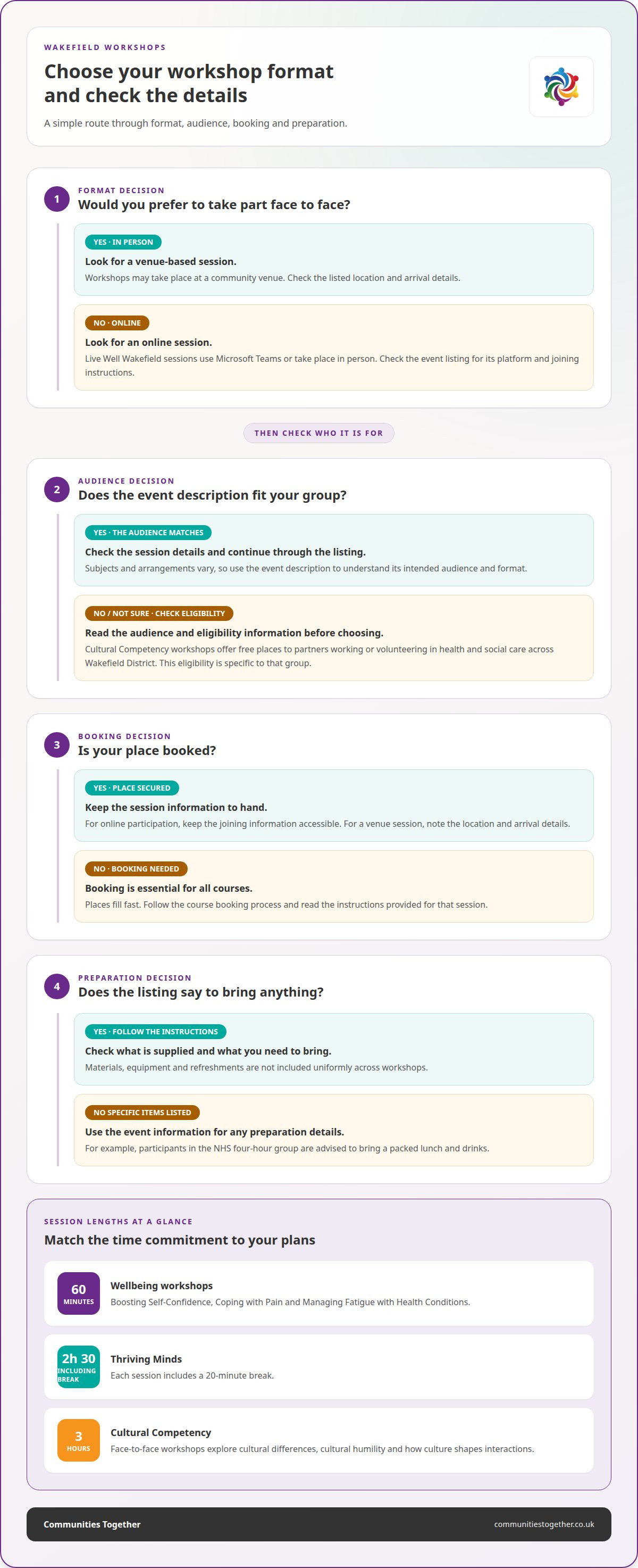
Live Well Wakefield workshops take place online via Microsoft Teams or in person at a community venue. Online sessions let participants join remotely, while venue-based workshops bring the group together face to face. Check the event information for its format and joining arrangements, then choose the setting that best supports your participation and learning.
For an online workshop, note the stated platform and joining instructions when booking. Media Trust’s webinar on helping charities appear in AI search is one example. In-person sessions take place at community venues, so use the listed location to plan your attendance. The format is a practical starting point when comparing opportunities.
Booking is essential for all courses because places fill fast. This makes registration an important step, whether the event is online or in person. Use the course booking process to secure a place and read the instructions supplied for that session. For online participation, keep its joining information accessible; for a venue session, note the address and arrival details.
Beginner access and eligibility
Workshop audiences and entry arrangements vary, so read each description to understand who the event is for. Cultural Competency workshops offer free places to partners working and volunteering in health and social care across Wakefield District. This eligibility applies to that group, not to every local workshop.
Materials, equipment and refreshments aren’t included uniformly across workshops. Event information explains what is supplied and what to bring. For example, participants in the NHS four-hour group should bring a packed lunch and drinks. Check the event’s joining or booking details for any other preparation.
If you’re attending for the first time, read the event description, identify its intended audience and follow the booking instructions. Look for stated prerequisites or preparation rather than assuming every session has the same entry conditions. This is useful when comparing a professional session, such as Cultural Competency, with a public webinar.
Before registering, choose an online or venue-based format, note the joining details and record anything the organiser asks you to bring. For Microsoft Teams events, keep the joining information handy. For face-to-face sessions, use the venue details to plan your arrival. These steps help you prepare for the event you choose.
What subjects and practical skills do Wakefield workshops cover?
Wakefield workshops cover wellbeing, cultural understanding, education and personal learning. Their practical value depends on the subject, intended participants and skills explored. Cultural Competency workshops, for example, examine how cultural differences can affect interactions. They also explore cultural humility and how culture can be understood individually and within wider society.
These themes help participants consider how people’s experiences and social contexts shape communication. Cultural humility encourages reflection rather than treating culture as a fixed set of assumptions. The workshops connect this reflection to interactions with others, which can be relevant to partners working and volunteering in health and social care across Wakefield District.
Education-focused learning appears in grammar workshops centred on the expected standard and beyond for Year 6 writing. This gives the subject a defined stage and focus. The practical emphasis is writing, rather than general study skills. For families and learners considering this type of session, the Year 6 reference helps clarify whether its educational focus matches their needs.
Wellbeing is another focus of Wakefield workshops. Examples include Boosting Self-Confidence, Coping with Pain and Managing Fatigue with Health Conditions. These topics address different interests, from confidence to living with health conditions. Thriving Minds is another named wellbeing option. Together, the examples show how local learning can address personal wellbeing alongside cultural and educational subjects.
To compare subjects, identify the skill or area of understanding you want to develop first. Then match it to the workshop’s stated focus. A session on cultural competency is relevant to understanding interactions and culture. A Year 6 grammar workshop has a more specific writing focus. A wellbeing workshop addresses a different learning need, so its title can help distinguish it.
Practical learning does not always mean practising a technical task. Cultural Competency workshops focus on understanding cultural differences, humility and social context. These themes can inform how participants interpret interactions with others. By contrast, Year 6 grammar workshops focus on writing standards. The subject itself therefore shapes what participants can expect to explore and apply after a session.
Compare opportunities by subject rather than assuming every workshop teaches the same skills. Consider cultural understanding, writing and wellbeing as separate learning pathways, then review the intended audience and session description. Examples from Wakefield District show how specific workshop topics can be within the broader field of community learning.
Are Wakefield workshops open to beginners, and what age or eligibility rules apply?
Entry arrangements in Wakefield depend on the workshop’s audience and subject. Cultural Competency workshops, for example, offer free places to partners working and volunteering in health and social care across Wakefield District. That eligibility detail applies to those places, rather than describing every local course. A Year 6 grammar workshop has a clearly stated learning stage, which helps identify its intended participants.
For beginners, start with the event description and look for any stated experience or entry requirements. The available examples cover different kinds of learning, from cultural understanding to Year 6 writing, so one assumption cannot describe every session. Participants are not required to write or speak in front of others during the workshops. This can help clarify what participation involves, though it does not itself define a beginner-level course.
Age and stage can be signalled through the subject. A grammar workshop focused on the expected standard and beyond for Year 6 writing is directed towards that educational stage. By contrast, the Cultural Competency eligibility information identifies working and volunteering in health and social care across Wakefield District. These examples show why the intended group matters as much as the workshop title.
Use a simple three-step approach when assessing suitability:
Read the workshop description for its intended audience, such as Year 6 learners or health and social care partners.
Look for any stated experience, age or participation requirements.
Match those details to the participant’s circumstances and learning aim.
This approach helps distinguish an open learning opportunity from one aimed at a defined group. For example, the free places at Cultural Competency workshops are specifically for partners working and volunteering in health and social care across Wakefield District. The Year 6 grammar focus provides another clear audience marker. Neither example should be treated as a rule for unrelated workshops.
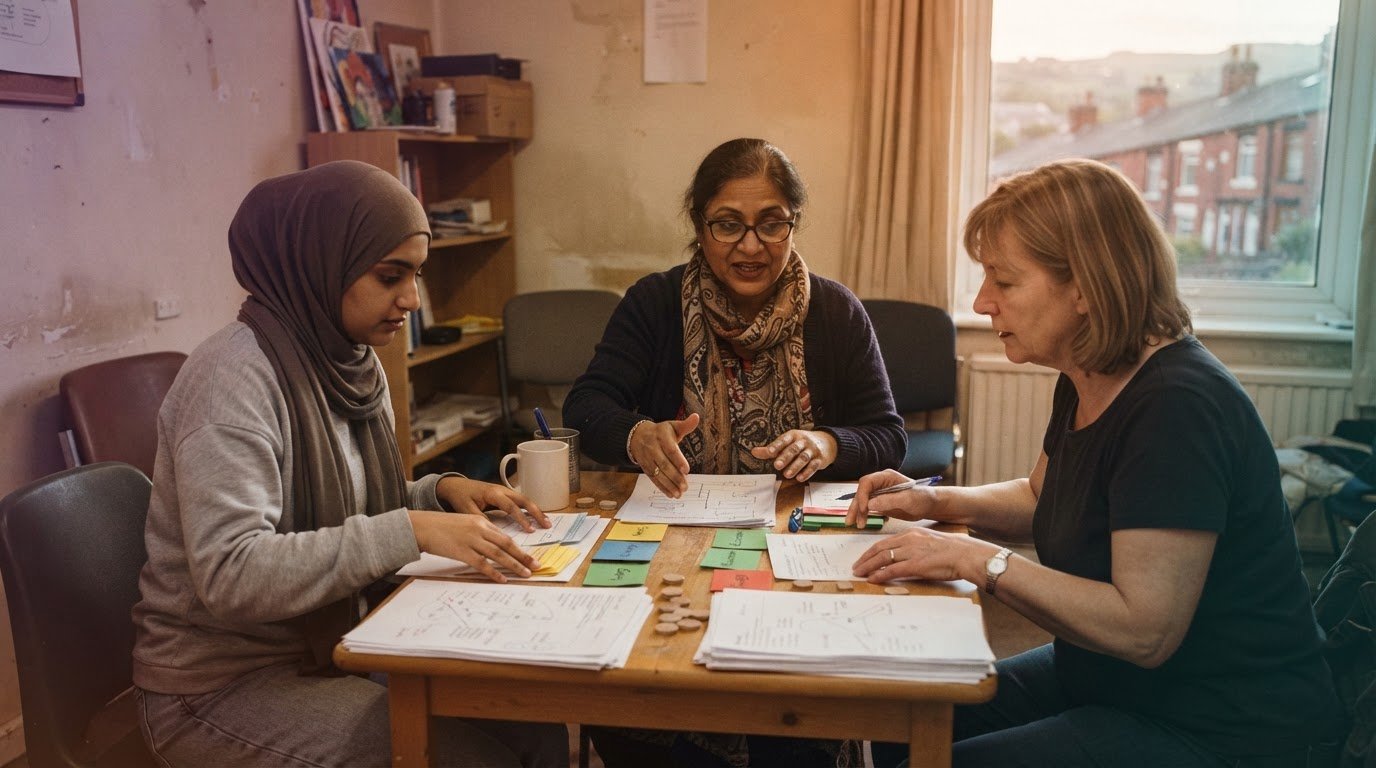
If you’re new to a subject, consider how the session is organised. Cultural Competency workshops use a participatory approach and aim to create a safe space for conversation. Participants aren’t required to speak or write in front of others. These details describe participation, not prior knowledge, so check the event’s intended audience and any stated prerequisites.
In practice, the clearest answer comes from the individual listing: check the named audience, any entry conditions and the expected form of participation. A Year 6 writing session and a professional Cultural Competency workshop illustrate different eligibility cues. Reading those details before booking helps participants choose a session aligned with their stage, role and learning interests.
Are there skills workshops in Wakefield for young people, adults, or specific groups?
Yes, Wakefield District has learning opportunities aimed at different audiences, rather than one format for everyone. Examples include a grammar workshop focused on Year 6 writing, professional learning for health and social care partners, and activities linked to business skills. The workshop description helps show who a session is designed to serve.
For young learners, the clearest example is the grammar workshop, which focuses on the expected standard and beyond for Year 6 writing. Its stated stage and subject make its audience more specific than a general community course. Families looking at learning opportunities can use that focus to decide whether the session matches the learner’s current educational stage.
Adults can find sessions on professional practice, wellbeing and health conditions. Cultural Competency workshops are intended for partners working and volunteering in health and social care across Wakefield District. They explore how cultural differences can affect interactions with others, making the subject relevant to people in those roles. Free places are available to these partners.
Other opportunities focus on particular interests or settings. The Business and Skills Community Hub in Castleford began as a six-month pilot, with a focus on business and skills. The Heart of Yorkshire Education Group includes Castleford College, Wakefield College and Selby College. These examples illustrate the range of educational and skills contexts in the area, but don’t imply that every activity is open to every age group.
Some opportunities are defined by their subject rather than an age group. Boosting Self-Confidence, Coping with Pain and Managing Fatigue with Health Conditions are named workshop topics. A charity-focused online webinar scheduled by Media Trust is another example, designed around a particular organisational interest. Check each listing’s audience and subject before booking.
To find a suitable option, match the participant’s stage, role or learning interest with the event description. A Year 6 writing focus differs from a session for health and social care partners. Business and skills activities have another emphasis. This distinction helps avoid treating “community workshop” as one audience category, and supports a more considered choice based on the stated purpose.
Consider the intended group, subject and participation details together. Cultural Competency workshops use a participatory approach and aim to create a safe space for conversation. Participants aren’t required to write or speak in front of others. These details describe the session experience, while the audience criteria show who it is for.
Communities Together: Wellbeing and Resilience Workshops
Communities Together runs Wellbeing and Resilience Workshops for people seeking supportive learning and personal development. They’re a relevant option if you want to build wellbeing and resilience through a community-focused approach, rather than attend a session centred on another subject.
Communities Together also offers Learning, Skills and Personal Development, Community Engagement Programmes, and South Asian Arts and Heritage Activities. These activities connect individual learning with participation, cultural understanding and stronger community relationships. They may suit your goals if you’re interested in wellbeing, resilience, personal development or community engagement.
If you’d like to discuss these workshops, contact Communities Together.
Shape your next step through community learning
Community skills workshops in Wakefield can help you develop personal interests and strengthen connections with others. Consider what you want to build next, whether that’s confidence, shared learning or a stronger role in community life. A clear purpose can help you find activities that feel relevant to you and the people around you.
Communities Together delivers Community Engagement Programmes, South Asian Arts and Heritage Activities, and Wellbeing and Resilience Workshops. These offer different routes into participation, cultural learning and personal development. If one of these areas fits your interests, get in touch with Communities Together to discuss how its programmes relate to your aims.
Take the next step at a pace that feels right for you. Community learning grows through shared ideas, respectful participation and ongoing opportunities to contribute.
There’s room to keep learning and shaping stronger connections.
Frequently Asked Questions
What community skills workshops are available in Wakefield?
Wakefield listings include wellbeing, cultural competency, education, business and charity-related learning. Examples include Thriving Minds sessions, grammar workshops focused on Year 6 writing, and Cultural Competency workshops for health and social care partners. For community skills workshops in Wakefield, the most useful starting point is the subject and intended audience, since these show whether a session matches your learning aim.
Which organisations and venues run skills workshops in Wakefield?
Wakefield Council, Live Well Wakefield, Mid Yorkshire NHS Teaching Trust and Media Trust feature in the local and nearby learning opportunities described here. Castleford’s Business and Skills Community Hub is another named local facility. Events use different settings: Live Well Wakefield offers online sessions through Microsoft Teams and in-person sessions at community venues. Each event listing identifies the relevant venue.
When are upcoming community skills workshops in Wakefield?
Media Trust scheduled an online webinar about helping charities appear in AI search for Tuesday 24 November, from 9.30am to 11.30am. The “Thrive - Reset, Re-Charge” day at Hebden Bridge Town Hall was scheduled for 20 November, so that date has passed. Dates differ between organisers and sessions; use the event title and scheduled time to distinguish a forthcoming opportunity from an earlier listing.
How can I book or register for a Wakefield community workshop?
For Wakefield Council courses, booking is essential because places fill quickly. Follow the instructions for the specific course rather than assuming every organiser uses the same registration process. Before registering, note the format, start time and venue, or save the online joining information. This helps you prepare and distinguish an online event from a venue-based session.
How accessible are Wakefield workshop venues, and what support is available?
Access depends on the venue and session format, so use the event details for location and participation arrangements. Live Well Wakefield offers Microsoft Teams sessions as well as workshops at community venues. Participants in the described workshops aren’t required to write or speak in front of others, which may suit people who prefer not to contribute publicly.
Comments