
Community capacity building: how communities grow skills and influence
Communities become more resilient when people have the skills and influence to shape the decisions affecting their lives. Community capacity building in the UK supports this by strengthening local knowledge, relationships and leadership, so residents and groups can identify priorities and take collective action. Co-production is central: people contribute to designing and delivering responses, rather than being treated only as recipients of support.
Community capacity building UK means more than running a one-off activity. It involves creating space for people to share experience, develop practical skills, build partnerships and influence decisions about resources, while recognising strengths already present in the community. This can help local groups respond to challenges with greater confidence and sustain action over time.
This article explains how community capacity building works, what skills and relationships it can develop, and how co-production can turn local insight into collective influence. It also considers the role of appropriate support, community-led priorities and partnership working in strengthening resilience across communities.
Table of Contents
Community action and empowerment
Community action begins when residents can define an issue, shape a response and influence decisions about delivery. A community-led plan might address an underused shared space, limited opportunities for young people or barriers to local participation. The priority itself matters less than who sets it: residents need room to describe the problem in their own terms. This moves people beyond being consulted after decisions are made and gives them an active role in setting direction.
A two-day community capacity consultation took place at St George’s House, Windsor Castle, in February 2026. Practitioners and leaders from local and central government, community organisations, funders, academia and civil society met to discuss community capacity building. The breadth of participants highlights a practical consideration for local action: residents, organisations and public bodies may each hold different knowledge and influence. Effective planning makes those differences visible, then clarifies how each group can contribute without displacing residents’ priorities.
Scotland’s Achieving Community Empowerment (ACE) was a national community capacity building programme that ran from 2009 to 2014. It provides a named example of community empowerment being addressed through a programme rather than a single local activity. For a local group, the underlying planning task is to connect shared priorities with clear responsibilities. A plan should identify the change residents want, the people who can contribute, the resources available and how progress will be discussed.
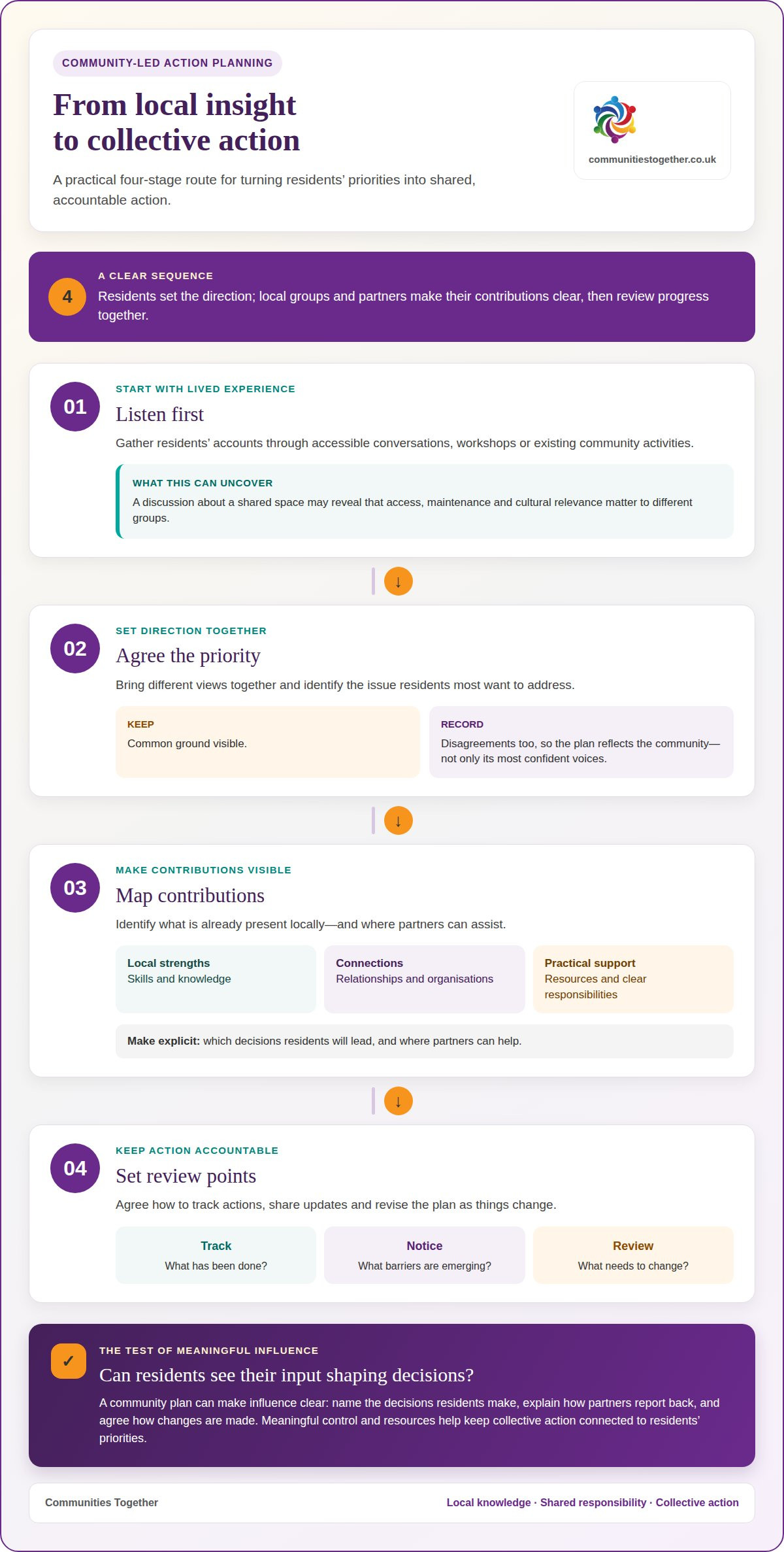
Community-led action planning can follow a clear sequence:
Listen first. Gather residents’ accounts through accessible conversations, workshops or existing community activities. For example, a discussion about a shared space may reveal that access, maintenance and cultural relevance matter to different groups.
Agree the priority. Bring those views together and identify the issue residents most want to address. Record disagreements as well as common ground, so the plan reflects the community rather than only its most confident voices.
Map contributions. Identify local skills, relationships, organisations and practical resources that could support the response. Make responsibilities clear, including which decisions residents will lead and where partners can assist.
Set review points. Agree how the group will track actions, share updates and revise the plan. A regular review can distinguish completed tasks from emerging barriers and keep accountability connected to residents’ aims.
Empowerment depends on influence, not simply attending a meeting. A neighbourhood programme should give residents meaningful control and resources, supported by clear accountability. A community plan can specify which decisions residents make, how partners report back and how changes are agreed. These steps make collective action more transparent, strengthen local leadership and help direct activity towards priorities residents have chosen.
Community resilience and co-production
Resilience is a community’s ability to respond, adapt and maintain relationships through change. If a neighbourhood faces the closure of a shared space, for example, residents may need to bring together local knowledge, skills and practical support. Co-production lets residents and organisations shape the response together: residents contribute lived experience, while partners bring relevant expertise and resources. The work is stronger when everyone agrees how decisions will be made, who will act and how progress will be reviewed.
Co-production means more than asking residents to comment on a finished plan. In a local wellbeing project, residents might identify barriers to participation, help choose suitable activities and review how the project works. Practitioners can contribute their knowledge to delivery while keeping community priorities central. This shared process can build trust by showing how people’s contributions affect decisions, and helps partners recognise when a response needs to change.
Before an activity begins, a group can agree a few practical ways of working. These should explain how residents can participate, how decisions are recorded and how concerns can be raised. For a neighbourhood project, a working group might agree:
Shared priorities: Record the community’s intended change, such as improving access to a local activity.
Decision-making: Make clear which choices residents lead and where partners provide support.
Accessible participation: Offer different ways to contribute, including discussion groups and written feedback.
Learning and review: Set a process for considering feedback and adapting activities as circumstances change.
Clear arrangements help knowledge and relationships remain useful beyond a single activity. If a project team changes, for instance, shared records and responsibilities can maintain continuity. A group can also map local skills, identify gaps and connect residents with partners who can contribute. This makes it easier to respond together when priorities shift, rather than relying on one person to hold all the knowledge.
Co-production also requires attention to influence. If residents contribute ideas but cannot affect decisions, participation may feel symbolic. A practical test is whether the group can point to a decision that changed through community input. Regular feedback sessions can explain what changed, what remains unresolved and why. For organisations seeking structured ways to involve residents and build collaboration, community engagement programmes can support this shared work.
Community resources, skills and knowledge
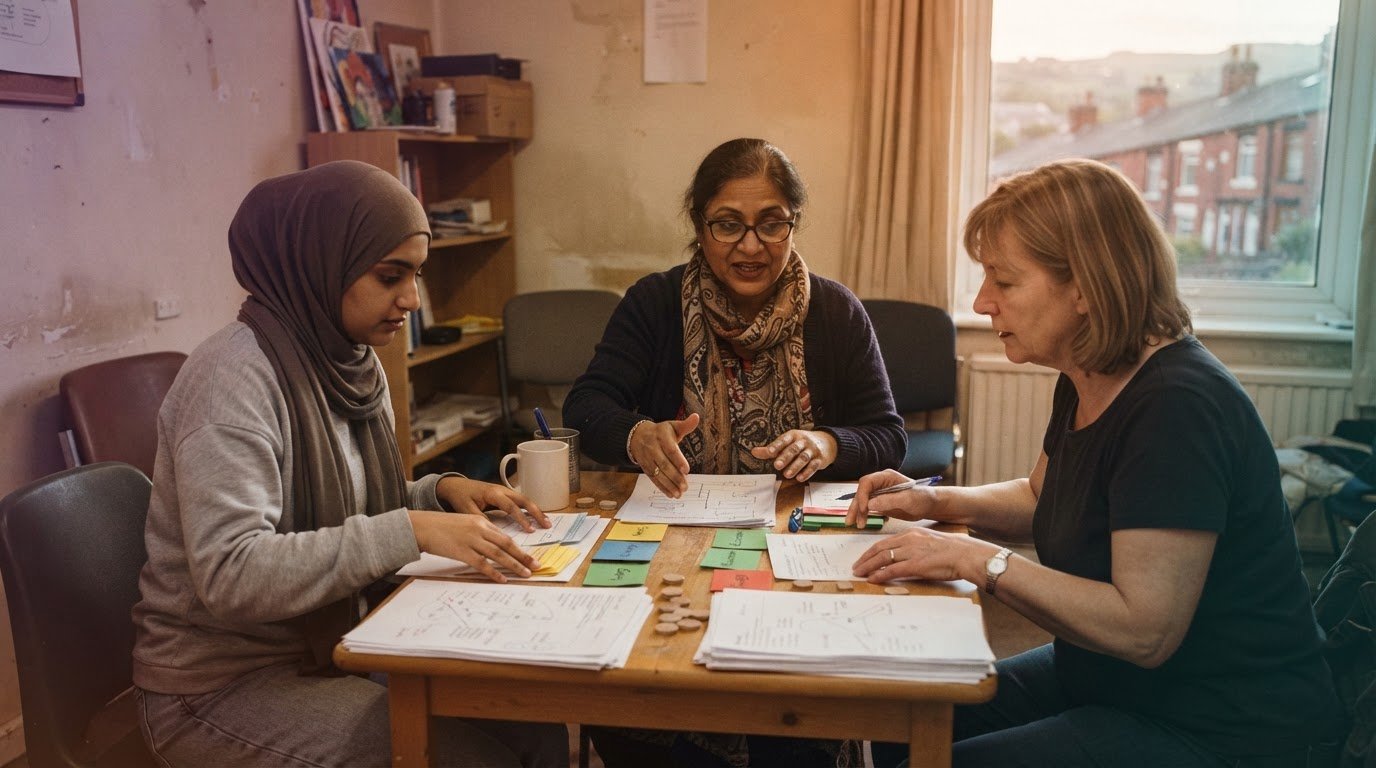
Start by mapping what people already contribute, rather than viewing a community as lacking resources. For a neighbourhood food-growing project, that might include residents’ gardening knowledge, access to tools, translation skills and relationships with local schools. A map can also record practical assets such as meeting rooms, transport links and existing groups. Making these contributions visible helps a project see where additional support could make a difference.
Skills mapping works best when it recognises experience people may not call expertise. Someone who organises an informal support network may have strong coordination skills; a resident who welcomes newcomers may know how to build trust across groups. A short conversation, group activity or skills-sharing session can bring these strengths to light. Record what people are willing to share, what they want to learn and what would make participation easier.
A simple resource map can organise findings into useful categories:
People and skills: Note practical abilities, languages, cultural knowledge and leadership experience that residents choose to contribute.
Places and equipment: Identify accessible rooms, gardens, tools or digital facilities relevant to the activity.
Relationships: Record links between residents, local groups, schools and public services that could support collaboration.
Learning needs: Identify skills people want to develop, such as budgeting, facilitation or communicating with decision-makers.
A local history project, for example, could bring together residents’ memories, photography skills and knowledge of community languages. If the group identifies a need for help recording oral histories, it could arrange peer learning before collecting material. This treats knowledge as something shared across generations and experiences, not held only by formal specialists. Clear agreements about how contributions will be used can also strengthen trust and support continued involvement.
Resources include more than equipment or funding. Time, confidence, relationships and access to useful information can all shape what a group can sustain. A charity in England and Wales may use an object focused on developing the capacity and skills of a socially or economically disadvantaged community so its members can identify and help meet their needs and participate more fully in society. This connects skills development with practical agency: learning matters because people can apply it to priorities they identify.
To turn a resource map into action, link each priority to an existing strength and a learning opportunity. If residents have local knowledge but need support presenting recommendations, a facilitated practice session can help them communicate clearly. Review the map as the project develops, because new relationships and skills emerge through activity. This keeps plans grounded in what people can contribute, want to learn and need to participate more fully.
Definition of community capacity building
Community capacity building is the process of strengthening people’s ability to identify shared needs and respond together. It develops skills, relationships, knowledge and local leadership, while helping communities influence decisions that affect them. Residents improving a shared space, for example, might learn to organise meetings, connect with local organisations and present their priorities. The aim is not just to deliver an activity, but to help the community shape and sustain its response.
In the UK, community capacity building can bring together residents, voluntary groups, public bodies and other local partners. Each can contribute different resources, while residents retain meaningful influence over priorities and decisions. In a neighbourhood learning project, for instance, residents could choose topics, shape sessions and review what they found useful. That is what distinguishes capacity building from a service delivered without community involvement.
How is community capacity building measured and evaluated? Agree the intended change with the community, then track relevant signs such as new skills, stronger partnerships, sustained group activity or greater influence over decisions. Combine residents’ feedback with practical records, such as participation and completed actions, and review whether the evidence reflects their priorities.
Benefits can include stronger local leadership, improved collaboration and a greater ability to respond to shared challenges. Risks arise when participation is tokenistic, the same small group carries too much responsibility, or partners withdraw resources without a sustainable plan. A local project can address these risks through transparent decisions, shared responsibilities and regular reviews of whether residents have genuine influence.
Evaluation should consider both outcomes and the process behind them. A project might record whether residents gained facilitation skills, then ask whether they had opportunities to use those skills. Attendance alone does not show whether people influenced decisions or built lasting relationships. A reflective discussion after an activity can clarify what changed, who benefited and what should happen next. Comparing feedback over time can reveal progress a single final review might miss.
A useful evaluation framework links each intended change to evidence the community can understand and discuss. For a gardening project, the group could consider whether residents can organise sessions, share knowledge and stay involved. It could also look at barriers such as inaccessible meetings or unclear responsibilities. If results differ from expectations, the group can adapt its approach while keeping community priorities central.
Community capacity building UK is best understood as an ongoing process, not a one-off intervention. A resident group that develops skills, relationships and influence can draw on those strengths as new priorities emerge. Reviewing who shapes decisions, how knowledge is shared and whether activity continues offers a practical way to understand the work’s contribution.
Support for community groups
Community groups access support to address issues that matter to them. This can include developing leadership, strengthening skills or building partnerships around a shared priority. Evidence from the Big Local place-based programme indicates that appropriate support can help build community capacity and leadership. The right support responds to a group’s aims and circumstances, rather than prescribing a standard activity for every neighbourhood.
Community capacity-building policies and funding differ across England, Scotland, Wales and Northern Ireland. Each nation has distinct public-sector and funding arrangements, so priorities, eligibility and application routes can vary. Groups should identify their nation and local area, then compare their aims with relevant funders’ published criteria.
There is no standard UK-wide cost for support. The price depends on the case and is given after a quote request, with the scope, delivery format and duration shaping it.
Grants may support capacity building when their aims include skills, leadership, participation or community-led action. Eligibility depends on each funder’s criteria, which may cover applicant type, location, intended beneficiaries, project outcomes and eligible costs. Explain how the proposed activity matches the funder’s priorities instead of assuming every grant supports organisational development.
Before applying, define the issue the group wants to address and the support needed. A residents’ group seeking greater influence over local decisions, for example, might need help developing facilitation skills, organising its views and communicating with partners. A clear proposal links that need to practical activity and explains how the group will use what it learns.
A considered support plan can include these steps:
Clarify the priority. Describe the issue in the group’s own terms and explain who is affected.
Identify the capacity gap. Specify whether the group needs skills, stronger relationships, leadership development or help coordinating activity.
Match support to need. Choose an approach that strengthens the group’s ability to act, rather than replacing its role.
Agree how progress will be reviewed. Decide what evidence will show whether the support is useful, such as improved participation or clearer shared responsibilities.
Support can help groups manage practical challenges such as uneven workloads, limited confidence or difficulty sustaining activity. A partner might facilitate a planning session, help members share responsibilities or create opportunities to practise presenting ideas. This is most useful when the group keeps ownership of its priorities and can apply its learning after the activity ends.
For community groups developing skills, leadership and collective action:
Communities Together: Partnership and community Capacity Building
Communities Together supports local groups through Partnership and Community Capacity Building, helping strengthen the skills and relationships needed for collective action. This support can help residents who have identified a shared priority build their capacity to work together. Community Engagement and Cohesion programmes create opportunities for inclusive participation, while Health, Wellbeing and Social Connection activities support work focused on community wellbeing. South Asian Arts and Culture programmes and Heritage and Cultural Preservation projects help communities engage with cultural knowledge and heritage.
The right approach depends on what the community wants to develop, whether that is stronger partnerships, wider participation or skills for sustained activity. Contact Communities Together to discuss your community’s priorities.
Turn shared priorities into lasting action
A thoughtful approach to community capacity building UK starts with a next step local people can shape and sustain. A group might bring residents together around a shared priority, identify the support they need and agree how to work collectively. Progress can begin with a practical conversation and develop through learning, partnership and ongoing reflection.
Communities Together supports this work through Community Engagement and Cohesion programmes, South Asian Arts and Culture programmes, and Health, Wellbeing and Social Connection activities. These offer ways to strengthen participation, connect people through culture and support community wellbeing. The best starting point depends on what residents want to develop and how they hope to take part.
Local knowledge and shared commitment provide a strong foundation for what comes next. With a clear priority and space for people to contribute, communities can keep building their influence together.
Frequently Asked Questions
What does community capacity building mean in the UK?
Community capacity building means helping people and local groups develop the ability to shape and act on shared priorities. A group in Bradford, for example, might want to make a community activity more accessible, then build the skills to organise it and involve residents in decisions. The focus is strengthening local agency, rather than delivering an activity on a community’s behalf.
What are the main community capacity building programmes in the UK?
There is no single programme format for every community; activities take shape around local needs and priorities. They may focus on resident participation, leadership development, skills learning, cultural heritage or wellbeing. A group interested in South Asian heritage, for example, may take part in arts and cultural activities, while another may want to strengthen community connections or practical skills.
Which UK organisations provide community capacity building support?
Communities Together provides community capacity building and engagement support in Huddersfield, Halifax, Leeds, Bradford and Wakefield. Its work includes Community Engagement and Cohesion programmes, South Asian Arts and Culture programmes, and Health, Wellbeing and Social Connection activities. These can support local groups seeking to strengthen participation, connect people through cultural activity or improve community wellbeing. The focus depends on each group’s priorities and the development it wants to pursue.
How can a community group apply for UK capacity-building funding?
Begin by describing the group’s purpose, the people it serves and the capacity it wants to develop. Then identify a funder whose published priorities fit and read its eligibility and application requirements. A proposal for facilitation training, for instance, should explain how the learning will help the group pursue its community aims. Set out the intended activities, responsibilities and how progress will be assessed.
What training and skills do community capacity-building programmes offer?
Training can develop practical skills that help people participate and organise local activity. Depending on the programme, it may cover facilitation, communication, leadership, partnership working or personal development. A resident who wants to contribute to a local project, for example, might build confidence speaking in group discussions. Learning is most useful when it connects directly with community priorities and gives participants opportunities to apply their new skills.
Comments