
Adult learning courses in Wakefield: costs, levels and support
For adult learning courses in Wakefield, what you pay depends on the course and your eligibility for funding. Wakefield residents earning less than £25,750 a year may qualify for full funding for courses that have fees, so exploring support options can be as important as comparing course levels.
It’s understandable to want a clear idea of costs before committing time to study, especially when balancing learning with work, family or other responsibilities. This guide explains how course fees and funding may affect your decision, and what to compare when exploring adult learning courses in Wakefield.
You’ll find an overview of course levels, locations and enrolment support, alongside part-time and professional study routes. We’ll also cover practical details to compare across local options, helping you identify what matters as you plan your next step.
Table of Contents
Course levels and smaller in-person classes
Entry requirements for adult courses in Wakefield depend on the subject and qualification. Some courses welcome beginners, while advanced study may require relevant experience or previous learning.
Course levels show the stage and depth of learning, helping you compare qualifications before choosing a route. Adult course listings in Wakefield include practical training, academic study and work-based learning, so the right starting point depends on your goal.
Wakefield Council’s video introduces online learning through its Adult Education Service, offering a useful look at one way to study.
To get started, compare the level, subject and delivery format listed for each course. A short course may focus on a specific practical skill, while a qualification can build knowledge across a broader programme. The listings show how these routes differ:
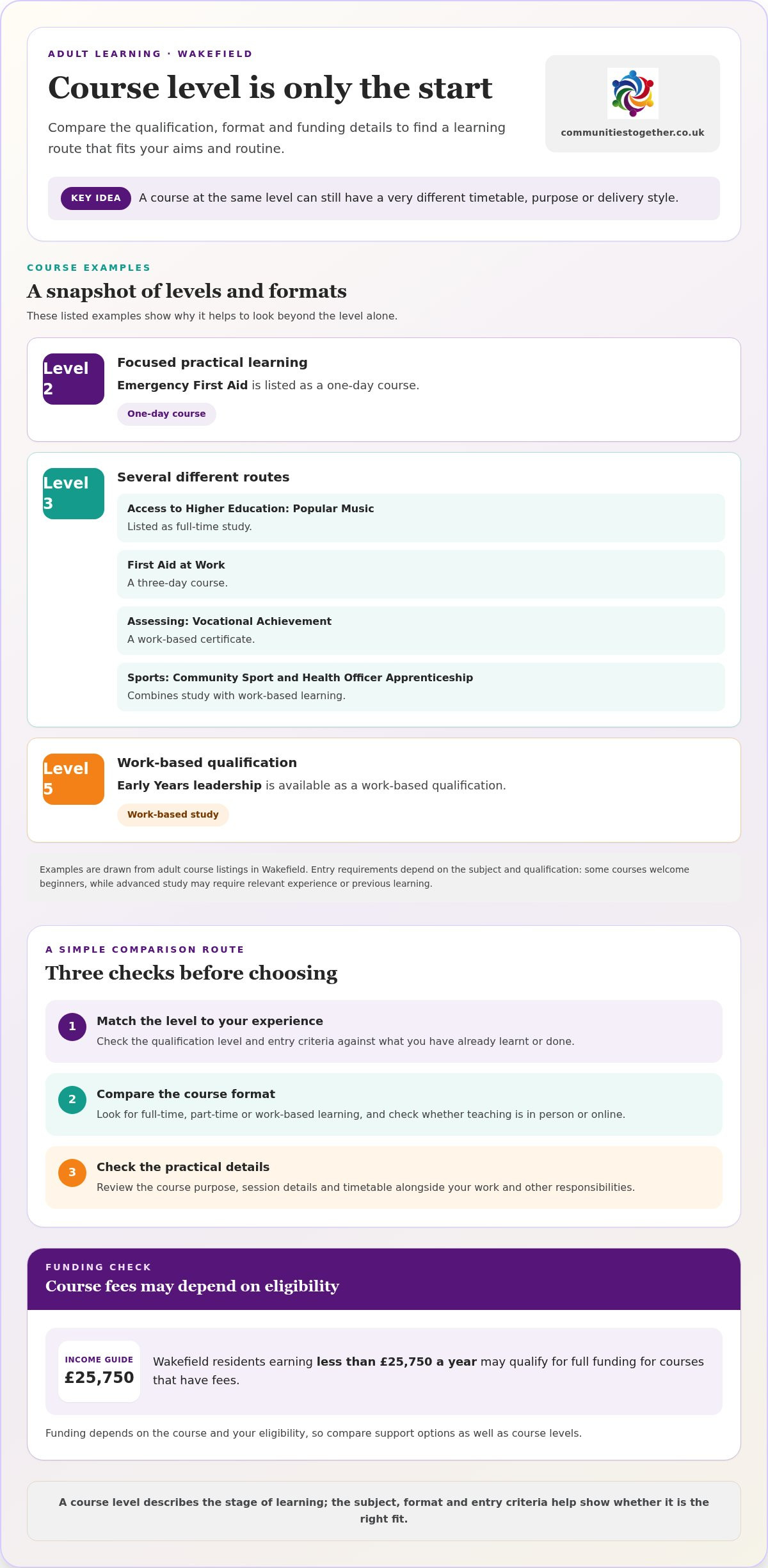
Level 2: a one-day Emergency First Aid course provides a focused example of practical learning.
Level 3: Access to Higher Education: Popular Music is listed as full-time.
Level 3: First Aid at Work is a three-day course.
Level 3: Assessing: Vocational Achievement is a work-based certificate.
Level 3: the Sports: Community Sport and Health Officer Apprenticeship combines study with work-based learning.
Level 5: Early Years leadership is available as a work-based qualification.
These examples show why the level alone doesn’t tell the whole story. A Level 3 course may be full-time, delivered over several days, or linked to employment. Compare the course purpose and format with your current skills, timetable and intended next step. For instance, someone seeking a professional qualification may value work-based learning, while a learner exploring higher education may focus on the Access course.
Smaller in-person sessions can offer space for questions, discussion and supported practice. This can matter for practical subjects such as first aid, where learners engage with the material rather than only read about it—an approach championed by professional providers such as First Medical Training Ltd when delivering hands-on medical emergency courses. Class sizes and teaching arrangements vary by course, so use the published format and session details to judge whether the learning environment suits you.
Wakefield is recognised as a UNESCO Global Learning City, placing adult education within a wider local learning culture. To make a considered choice, take three steps: identify the qualification level that matches your experience, compare full-time and work-based formats, then consider whether in-person or online learning best supports your routine. That process helps narrow the options without assuming every Level 3 course has the same entry route or workload.
Qualifications can support progression, but a course’s suitability also depends on its subject and pace. Review the entry criteria alongside the level to decide whether to begin, build on existing skills or pursue a more advanced route.
Adult courses across Castleford, Selby and Wakefield
Course options and venues vary across Wakefield and neighbouring communities. Compare each course’s location, timetable and learning format before deciding which fits your plans.
Course dates and times vary; there is no single schedule for all adult learning in Wakefield. Use the course listing to compare its start date, session times and venue.
Adult education providers
Wakefield Adult Education Service and Wakefield College are named providers in the local adult learning landscape. Their course listings help you compare subjects, study formats and venues. Communities Together works with communities across Wakefield, Leeds, Bradford, Halifax and Huddersfield, offering community-based learning as a different route from qualification-led study. Consider the course purpose as well as the provider when choosing.
Course dates and times
Course dates and session times depend on the programme and its format. A full-time course, such as Access to Higher Education: Popular Music, requires a different timetable commitment from part-time study. Compare the listed start date, weekly pattern and scheduled hours with work, caring responsibilities and travel. This helps you judge whether a course fits your routine before enrolling.
Location matters alongside subject choice. If you live in Wakefield, Leeds, Bradford, Halifax or Huddersfield, compare the venue with your usual travel arrangements. The course venue, not just the provider’s name, determines where you need to attend. Online delivery offers another way to study, as shown in Wakefield Council’s Adult Education Service learning video.
Use this simple process to compare courses in the area:
Choose the subject: identify whether you want academic study, practical skills or preparation for higher education.
Compare venues: note the course location and whether it offers online learning.
Review the timetable: record the course start date, session times and weekly pattern.
Assess the journey: consider your travel arrangements alongside the scheduled hours.
Digital skills can also shape your choice of format. Wakefield Council’s online learning example shows that remote study is part of the local education picture. Compare the delivery method with your access to a suitable study space and your confidence using online tools. In-person teaching may suit practical activities or learners who value direct discussion.
For a fair comparison, assess course content and practical details together. A course in Wakefield may suit your subject aims, while one elsewhere in the local area may better fit your usual travel or work pattern. Review the full listing, then shortlist options by venue, dates, session times and how the learning supports your next step.
Community-based learning and skills development can complement formal study by connecting personal learning with local participation.
Enrolment and learner support
Before enrolling on a Wakefield course, compare its fee, eligibility criteria and available support. Funding can reduce costs for eligible learners, while practical help may address travel, equipment or childcare needs.
Advanced Learner Loans are available to people aged 19 and over to help pay towards course fees. Wakefield residents earning less than £25,750 a year may qualify for full funding for courses that have fees. These options can make a difference when budgeting for education, particularly if course materials or travel also affect your plans.
Funding and other support are not the same. A loan helps pay towards eligible course fees, while support with travel, equipment or childcare may be available for some courses. Help depends on the learner’s circumstances. Base your enrolment decision on the course fee, support relevant to you and the study commitments involved.
A useful preparation process is to work through these steps:
Choose a course: note its subject, level, venue and timetable.
Review the fee: establish whether the course has fees before planning your budget.
Consider funding: if you’re aged 19 or over, assess whether an Advanced Learner Loan could help towards fees.
Identify practical needs: list possible travel, equipment or childcare costs alongside course commitments.
Read enrolment details: follow the application steps and eligibility information for your chosen course.
Your course choice shapes what support matters most. For example, a creative course may involve equipment, while an English course may require regular attendance and study time. These examples don’t indicate a standard support package; they show why it helps to consider your circumstances alongside the specific course requirements.
For a clear budget, separate course fees from the costs of taking part. Travel, required equipment and childcare can affect the overall commitment, even when funding helps with fees. Listing these needs before enrolment gives you a fuller picture than considering the course fee alone.
Support can also affect which course is practical for you. If travel is a concern, compare the venue and timetable with your transport options. If childcare affects attendance, consider the session pattern before applying. For equipment needs, identify what the course requires and whether support may be available. These steps help you plan realistically around learning, work and family responsibilities.
Keep the funding criteria in view as you compare options. The age threshold for Advanced Learner Loans is 19 and over, while the stated full-funding threshold applies to Wakefield residents earning less than £25,750 a year and to courses that have fees. Reviewing those details alongside course requirements helps you prepare a focused enrolment plan.
Adult part-time and professional courses
Wakefield’s part-time options span vocational training, professional development, English and digital skills. Compare the course level, format and subject with your work or family commitments.
Vocational course options
Part-time vocational examples include Sports Massage at Level 3 and Level 4. Health and Social Care: Adult Care is a part-time Level 2 course for learners aged 19 and over. Business: Aspects of Preparing to Set Up a New Business is also part-time at Level 2. Compare the subject and level with your career aim before choosing.
English, maths and digital skills
A part-time GCSE English course is available, alongside ICT Functional Skills at Level 1. These options support different learning goals, from strengthening written communication to developing digital skills. For maths, consider the skills your intended qualification or role requires, and compare course objectives with that goal.
Professional study can also extend beyond entry-level vocational training. Wakefield’s course examples include a part-time Level 7 Management and Leadership Strategic Diploma. A Level 2 Mentoring course is another part-time option, offering a different route for learners interested in supporting others at work.
Use the course format as a practical filter. Part-time study can help you balance learning with employment, caring responsibilities or other commitments, but the weekly pattern still matters. Compare session times and course duration with your routine. For example, someone working shifts may need a timetable that fits their available study hours.
Apprenticeship and work-based learning routes connect training with employment. The Level 3 Sports: Community Sport and Health Officer Apprenticeship is one example. Early Years leadership at Level 5 is delivered through work-based learning, which may suit learners building experience with children. These routes differ from classroom-only study because learning is linked to a working context.
To shortlist options, start with the outcome you want, then match it to a course:
Career development: compare the Level 7 management diploma with the Level 2 mentoring course.
Practical vocational learning: consider Sports Massage at Level 3 or Level 4.
Care work: review the Level 2 Adult Care course and its age requirement.
Everyday learning: compare GCSE English with ICT Functional Skills at Level 1.
Check the qualification level and delivery method together. A Level 2 course may support a different starting point from a Level 7 diploma, while part-time study may help fit learning around existing responsibilities. For a business goal, the Level 2 course on preparing to set up a new business offers a focused subject choice. For learners seeking digital development, ICT Functional Skills provides a defined qualification level.
Which providers offer adult education courses in Wakefield?
Wakefield Adult Education Service and Wakefield College are names to consider when comparing local learning. Their course information can help you assess subjects, qualification routes and study arrangements.
Wakefield Adult Education Service features in a Wakefield Council video about online learning. Wakefield College is another local education provider, with adult courses in the wider Wakefield learning landscape. Provision varies, so compare individual course details rather than relying on provider names alone.
Wakefield College recorded an overall A-level pass rate of 98% in 2026. That figure describes A-level results, not adult course outcomes, so it should not determine your adult learning choice. Instead, consider the course’s subject, level, format and how it supports your own learning goal.
Use these steps to compare providers and courses:
Start with your goal: decide whether you want practical skills, a qualification or preparation for further study.
Compare course details: check subject, level, format and stated entry requirements.
Review the arrangements: note the venue, session times and whether teaching is online or in person.
Consider support: include funding eligibility and practical help in your decision.
Choose the best fit: weigh course content and arrangements against your circumstances.
For example, a learner seeking online study can look at Wakefield Adult Education Service’s online learning information. Someone considering college-based study can compare relevant Wakefield College course details. These examples show why teaching format and course information matter as much as the provider’s name.
Provider choice also depends on the type of learning you need. A qualification-led course and a skills-focused programme may have different entry criteria, teaching formats and outcomes. Read the course description to understand what learning involves, then compare it with your intended next step.
Geography is another practical factor. If you’re comparing provision around Wakefield, Castleford and Selby, check the named venue for each course. A provider’s general location does not tell you where every session takes place. Compare travel, timetable and delivery format together using the course listing.
Wakefield Council’s online learning video offers a starting point for understanding remote study, but it does not replace reviewing a particular course’s details. Before applying, bring together the provider, course title, level, entry criteria, venue and timetable. This makes comparisons clearer and helps you choose provision suited to your goals.
Communities Together: Community Engagement Programmes
Communities Together offers Community Engagement Programmes for people seeking learning through shared local activity and participation. If your aim is a formal qualification, compare the course routes covered above. If you’re looking to develop community connections, cultural understanding or collective wellbeing, Communities Together’s programmes may be a relevant next step.
Activities include South Asian Arts and Heritage Activities, Wellbeing and Resilience Workshops, and Heritage and Cultural Preservation. They create opportunities to learn together, share experiences and contribute to cultural continuity. This is community-based learning and development, rather than a substitute for a qualification-led course.
Choosing adult learning courses in Wakefield can be the start of a new direction, a stronger skill set or a closer connection with your community. Give yourself time to identify what you want learning to make possible, then choose a step that feels relevant to your interests and circumstances.
For learning rooted in community participation, Communities Together offers Community Engagement Programmes, South Asian Arts and Heritage Activities, and Wellbeing and Resilience Workshops. These provide ways to develop shared learning, cultural understanding and collective wellbeing alongside formal education. They may be especially relevant when your goal is participation and connection, rather than pursuing a qualification.
Whether you’re beginning a course or exploring community-based learning, each considered step can help you build knowledge and contribute to wider local connections. Your learning journey can start with the subject or purpose that matters most to you.
Take the next step at your own pace, with a clear sense of what you hope to learn and share.
Frequently Asked Questions
But what about the cost?
Course costs depend on the course fee and any funding you qualify for. Start by identifying whether your chosen course has a fee, then compare that amount with your eligibility for support. Wakefield residents earning less than £25,750 a year may qualify for full funding for courses that have fees. If you’re aged 19 or over, an Advanced Learner Loan can help towards course fees.
So, what’s actually on offer?
Wakefield’s adult provision covers academic, vocational, practical and professional learning. Examples include Access to Higher Education study, first aid, care, mentoring, management, English and ICT Functional Skills. To narrow your choice, start with the outcome you want: improving a core skill, gaining a work-related qualification or exploring further study. Then compare each course’s level, delivery format and entry criteria rather than choosing by subject title alone.
What Adult Education Courses Are Available In Wakefield For 2026?
Wakefield’s course listings include options at Levels 1, 2, 3, 5 and 7, across different subjects and formats. Examples range from ICT Functional Skills and GCSE English to work-based Early Years leadership and a Management and Leadership Strategic Diploma. These examples reflect the listed provision as of October 2026. Use the course’s own details to establish its current dates, study pattern, entry criteria and whether it matches your plans.
What adult learning courses are available in Wakefield?
Available subjects include English, ICT, business, health and social care, sports massage, first aid, mentoring, music and leadership. Some options focus on workplace skills, while others support academic progression or practical learning. If you’re unsure where to begin, write down the skill or outcome you want first. This makes it easier to compare courses with different qualification levels and study formats, then shortlist those that fit your aims.
How much do adult learning courses in Wakefield cost?
There isn’t one fee for every course; the cost depends on the course you choose. Check its individual listing for the fee and whether any fee applies. Your funding eligibility can then affect what you pay yourself. For budgeting, consider the course fee alongside travel, equipment and childcare needs, since practical costs can influence whether a course suits your circumstances.
Which courses are free or eligible for funding in Wakefield?
Advanced Learner Loans are available to people aged 19 and over to help pay towards course fees. Funding eligibility and a course’s fee are separate considerations, so compare both for your chosen option. Some courses may also offer help with travel, equipment or childcare, based on the learner’s circumstances.
How do I apply for an adult learning course in Wakefield?
Choose a course listing, then follow its application instructions to begin enrolment. Check the subject, entry criteria, timetable and delivery format before completing the steps provided. If funding is relevant, review your eligibility as you plan your application. Keep the course title and any details requested by the enrolment process to hand. This gives you a clear route from finding a suitable option to submitting an application.
Are online, evening or part-time adult courses available in Wakefield?
Online and part-time options are included in Wakefield’s adult learning provision. Wakefield Council’s Adult Education Service has an online learning resource, and course listings include part-time study. Evening schedules vary by course, so use each listing’s session times to see how it fits your routine. Compare delivery method, weekly pattern and travel needs together, particularly if you’re balancing study with work, caring responsibilities or other commitments.



Comments