
Wellbeing Programmes for Isolated Communities: A Comprehensive Resource Guide 2026
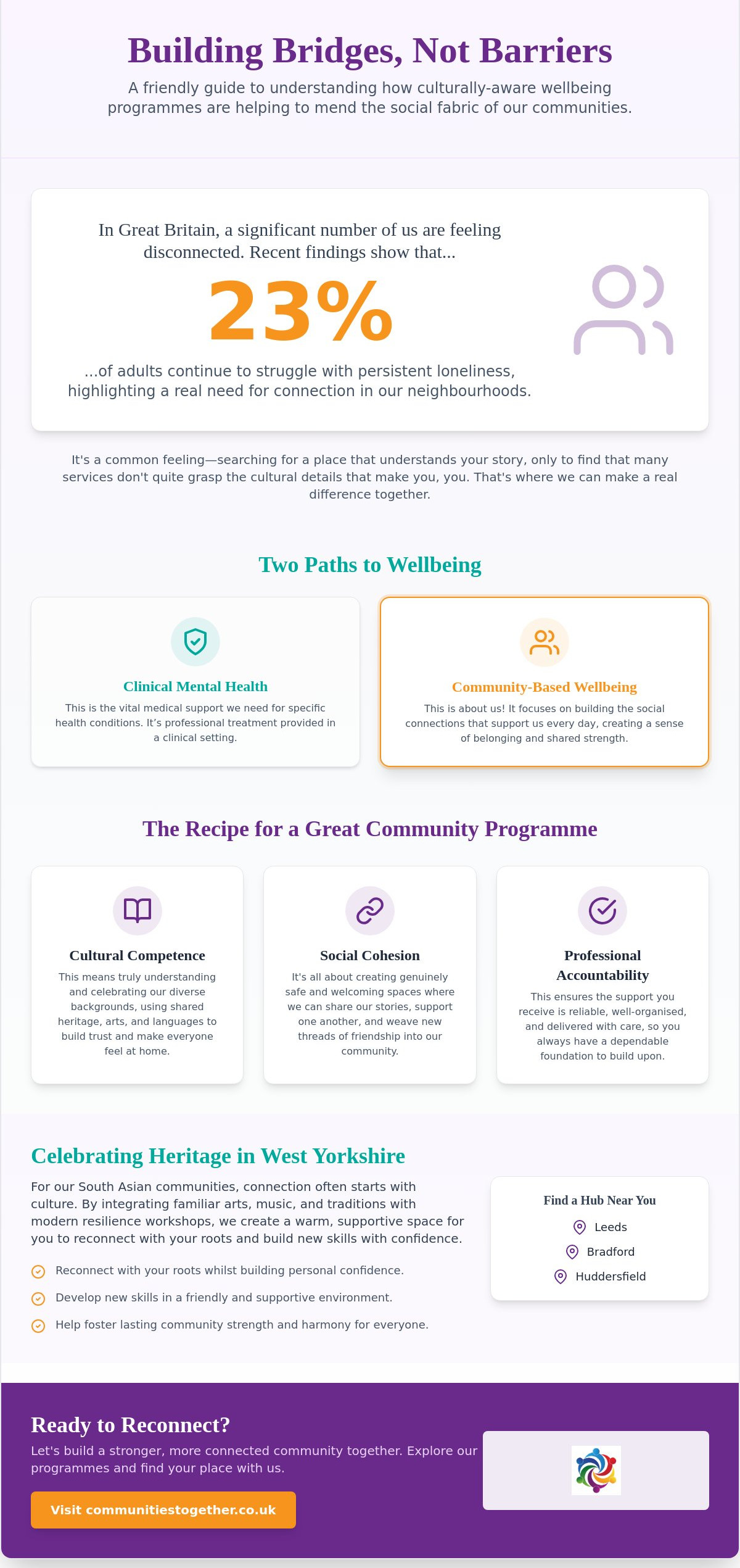
With recent data from February 2026 indicating that nearly 23% of adults across Great Britain continue to struggle with persistent loneliness, the need for inclusive, place-based support has never been more urgent for our local neighbourhoods. You've likely felt the frustration of seeking a space that truly understands your background, only to find that mainstream services often overlook the specific cultural nuances that make your community unique. We believe that meaningful connection is built upon a foundation of shared heritage and mutual respect, which is why we're dedicated to facilitating wellbeing programmes for isolated communities that prioritise cultural continuity, social harmony, and collective endurance.
In this comprehensive resource guide, you'll discover how culturally sensitive wellbeing programmes can effectively reduce social isolation and build lasting community resilience across West Yorkshire. We'll provide a detailed overview of the latest 2026 funding extensions for neighbourhood initiatives, explore the transformative potential of creative health projects, and offer practical pathways for you to reconnect with your cultural roots whilst developing new skills in a supportive environment. By focusing on professional advocacy and methodical community building, we aim to help you find a reliable foundation where your personal growth and our collective strength can flourish together.
Table of Contents
Understanding Social Isolation and the Role of Wellbeing Programmes
To truly address the challenges of our modern neighbourhoods, we must first understand that Social isolation represents a profound lack of meaningful contact that often leaves individuals feeling invisible within their own streets. Whilst clinical mental health support provides vital medical intervention for specific conditions, community-based wellbeing focuses on the broader social infrastructure that sustains us daily. It's about creating a sense of belonging, building structural strength, and ensuring that no one is left to face life's pressures without a reliable network of peers to lean on. Traditional outreach often misses the mark because it tends to treat people as cases to be managed rather than as members of a vibrant, though perhaps fractured, social fabric.
Establishing successful wellbeing programmes for isolated communities requires a shift away from clinical distance and towards the creation of genuine safe spaces where social cohesion can flourish naturally. These environments are essential because they provide the security needed for people to share their experiences, rediscover their confidence, and begin the process of reconnecting with the world around them. When we facilitate these connections, we aren't just helping one person; we're actively maintaining the health of the entire community by weaving new threads of trust and mutual support into the local landscape. This approach ensures that every individual has the opportunity to contribute to the collective endurance of their neighbourhood.
The Impact of Loneliness on Community Resilience
Individual isolation acts as a quiet weight that can gradually diminish the resilience of an entire neighbourhood, making it more difficult for residents to respond to shared challenges or celebrate collective milestones. We see a direct link between personal social connection and long-term community stability, as vibrant networks of support provide the foundation for safety, harmony, and local pride. Recognising the early signs of isolation, such as a neighbour no longer attending local gatherings or a family member becoming increasingly quiet, allows us to act as methodical advocates for their inclusion before their disconnect becomes chronic. It's these small, watchful acts of kindness that help us maintain a robust social fabric.
Why Culturally Sensitive Support Matters
For South Asian communities across West Yorkshire, the journey toward better health is often hindered by specific cultural stigmas and language barriers that make mainstream services feel unapproachable or irrelevant. By prioritising cultural continuity and using South Asian arts and heritage as a primary engagement tool, we can overcome these obstacles to build immediate trust and a sense of shared purpose. This approach ensures that wellbeing isn't seen as an abstract clinical concept, but as a lived experience that celebrates tradition whilst fostering the skills needed for modern community endurance. When wellbeing programmes for isolated communities are designed with this level of sensitivity, they become a powerful bridge between heritage and future progress.
Core Elements of Effective Wellbeing Programmes for Isolated Communities
Creating effective wellbeing programmes for isolated communities requires a methodical approach that prioritises inclusive engagement, cultural sensitivity, and professional accountability to ensure that every participant feels genuinely welcomed and valued. We've seen that by moving beyond simple social contact and focusing on the underlying social infrastructure, these initiatives can facilitate long-term stability, foster social harmony, and build collective endurance amongst diverse urban populations. A key component of this modern landscape is Social prescribing, which serves as a vital bridge between primary care and local community groups, allowing individuals to access tailored support that meets their unique cultural and social needs. Trust is the foundation of this work. This collaborative partnership building ensures that programmes remain sustainable whilst providing a warm, reliable foundation for personal growth and community development.
Arts and Heritage as a Wellbeing Tool
We believe that using South Asian arts and heritage acts as a powerful non-clinical intervention, providing a familiar and comforting bridge that encourages cultural participation, self-expression, and mutual understanding. These creative workshops do more than just teach a craft; they provide psychological benefits by reducing stress, improving focus, and creating a shared sense of accomplishment amongst group members. These initiatives also spark intergenerational conversations, allowing younger residents to learn from their elders whilst helping to reduce age-related isolation and maintain cultural continuity across the neighbourhood. By celebrating our shared history, we can build a more cohesive social fabric that supports everyone's wellbeing.
Building Resilience Through Skill-Sharing
Resilience is best cultivated through structured learning and personal development opportunities that empower individuals to move from passive participation to active community capacity building. This process often triggers a "confidence loop" where the following occurs:
Skill Acquisition: Mastering a new technique provides a tangible sense of progress and purpose.
Anxiety Reduction: Focused activity in a safe environment helps to lower social barriers and reduce personal anxiety.
Empowerment: Gaining new abilities encourages members to take on leadership roles or facilitate their own local groups.
We're dedicated to facilitating these workshops to help people build the practical skills, emotional strength, and social connections necessary for a thriving life. If you're looking for a welcoming space to start this journey, our wellbeing and resilience workshops offer a principled and supportive environment for your personal growth. By investing in these skills, we ensure that our communities possess the collective expertise to weave together a stronger, more resilient future for all.
Selecting the Right Programme: A Resource Guide for Decision-Makers
Selecting the right partner for social intervention is a critical decision that requires a deep understanding of how specific cultural contexts influence the success of community initiatives. When we evaluate wellbeing programmes for isolated communities, we must look beyond surface-level activities to ensure the provider possesses the expertise to navigate the challenges of wellbeing programs in remote areas whilst maintaining a steadfast commitment to inclusivity and social responsibility. This process involves examining their track record in fostering social cohesion, building structural strength within neighbourhoods, and facilitating long-term personal growth for every participant involved. With data from February 2026 showing that 23% of adults in Great Britain still report feeling lonely often or always, the choice of a programme that offers genuine, measurable social impact has never been more vital for our collective health.
A truly effective programme achieves a delicate balance between professional facilitation and community-led growth, ensuring that the organisation acts as a stable foundation rather than a temporary fix. We look for services that move beyond the "one-size-fits-all" approach, such as simple outdoor exercise, to provide indoor, creative, and culturally-specific engagement that resonates with the lived experiences of diverse populations. By prioritising activities that celebrate South Asian heritage and local traditions, we can build immediate trust, encourage active participation, and foster a sense of collective endurance that lasts long after the initial workshop concludes. This methodical approach allows us to measure social impact through increased volunteering rates, improved mental wellbeing scores, and a noticeable strengthening of the local social fabric.
Checklist for Community Leaders and Partners
When you're looking to establish a partnership for community capacity building, it's helpful to consider these specific markers of quality and accountability to ensure your goals align with the needs of the neighbourhood:
Does the programme offer dedicated South Asian arts and heritage activities to promote cultural preservation and social harmony?
Are the workshops designed to facilitate long-term resilience by teaching transferable skills, building personal confidence, and fostering mutual support?
Is there a clear, methodical pathway for participants to transition into community advocates who can lead their own local groups?
Questions for Families Seeking Support
Choosing a welcoming space for a relative involves more than just proximity; it's about finding an environment where they feel culturally understood and physically safe. You might find it useful to ask the following questions when exploring local wellbeing programmes for isolated communities:
Will my relative feel genuinely welcomed and culturally represented in this space through familiar languages, traditions, and social norms?
What specific wellbeing benefits and personal development skills will they gain to help them manage social anxiety and build new connections?
How does the organisation maintain high standards of safeguarding whilst ensuring inclusive participation for everyone, regardless of their background?
Wellbeing and Engagement Resources in West Yorkshire
West Yorkshire is currently witnessing a transformative expansion in local support infrastructure, as local authorities, academic institutions, and dedicated charitable organisations collaborate to deliver high-quality wellbeing programmes for isolated communities across our diverse urban centres. This collaborative approach is exemplified by the launch of the West Yorkshire Creative Health programme in the spring of 2026, which, backed by £500,000 from the West Yorkshire Combined Authority, seeks to integrate arts, music, and nature-based projects into the routine fabric of local health and prevention services. By mapping these resources across Huddersfield, Halifax, and Leeds, we can facilitate a more interconnected landscape where professional advocacy meets community-led growth to achieve lasting social cohesion, improved mental health, and structural strength within our neighbourhoods.
The strategic placement of local hubs in areas such as Bradford and Wakefield is essential for reducing travel barriers, ensuring that those who feel most disconnected can access support within their own vicinity without the burden of long-distance transport. These centres serve as vital connection points where South Asian cultural activities double as social catalysts, allowing residents to build new relationships whilst celebrating their shared heritage in a warm and welcoming environment. This place-based delivery model is further supported by the extension of the Know Your Neighbourhood Fund through to March 2026, which continues to widen participation in volunteering and tackle loneliness in 27 disadvantaged areas across England, including several key locations within our region.
Huddersfield and Halifax: Strengthening Local Bonds
In Kirklees and Calderdale, the focus remains on building robust community infrastructure that celebrates the unique industrial and cultural history of the area to foster local pride, encourage intergenerational dialogue, and maintain cultural continuity. Local heritage projects in Huddersfield and Halifax provide a reliable foundation for partnership and community capacity building, allowing residents to contribute to the collective endurance of their towns whilst gaining new skills. These initiatives are designed to be absorptive and reassuring, offering a steady pace of engagement that respects the traditions of the past whilst facilitating the progress of the future.
Leeds, Bradford, and Wakefield: Diverse Engagement Hubs
The cities of Leeds, Bradford, and Wakefield serve as vibrant hubs for inclusive community programmes, where South Asian arts and heritage activities play a central role in bridging the gap between diverse urban neighbourhoods. These city-based resources offer extensive opportunities for personal development and wellbeing workshops, helping individuals to improve their resilience through shared activities and collective learning. If you're looking to join a welcoming group that values your background, we invite you to explore our community engagement programmes to find a space where you can truly belong. By investing in these local hubs, we ensure that every resident has the opportunity to reconnect with their roots whilst building the skills necessary for a thriving life in West Yorkshire.
How Communities Together Supports Isolated Communities
As a methodical advocate for social harmony, Communities Together is deeply committed to delivering high-quality wellbeing programmes for isolated communities that provide a stable foundation for collective growth. We understand that true belonging is achieved when professional support respects cultural identity, which is why we meticulously blend our South Asian Arts and Heritage Activities with modern Wellbeing and Resilience Workshops to provide a supportive environment, facilitate personal growth, and foster long-term community strength. This unique approach ensures that participants don't just attend a session but instead enter a space where they can rediscover their roots whilst building the emotional resilience needed to thrive. By focusing on long-term social benefits rather than short-term excitement, we act as a reliable conduit for personal development across West Yorkshire.
Our work extends beyond individual support to encompass Partnership and community Capacity Building, where we collaborate with local groups to strengthen the underlying social fabric of our towns. We believe that by providing the right tools and professional guidance, we can empower residents to transition from participants into confident community leaders. This methodical process of learning, skills, and personal development is essential for maintaining the structural strength of our neighbourhoods, ensuring that every local group has the expertise to support its members effectively. For those interested in gaining professional qualifications to lead such initiatives, you can check out Active Health Group for accredited health coaching programmes. It's about building a legacy of togetherness that can withstand future challenges.
A Professional Approach to Social Cohesion
We employ a rigorous methodology for reducing isolation that prioritises cultural participation and heritage and cultural preservation as primary tools for engagement. By celebrating the rich history of South Asian communities, we help individuals build a stronger sense of local identity and pride, which serves as a powerful buffer against the pressures of social disconnect. We don't just facilitate workshops; we build bridges of understanding that allow residents to foster collaborative growth and mutual respect amongst their peers. This principled approach ensures that every project we undertake contributes to a more cohesive and resilient society where tradition and progress are valued in equal measure.
Get Involved with Communities Together
If you know someone who would benefit from a welcoming and culturally sensitive space, or if you're interested in joining a workshop yourself, we're here to provide a supportive path forward. We also welcome opportunities for local organisations to partner with us on resilience projects that aim to build lasting community strength and reduce travel barriers for those in remote areas. Our team is ready to facilitate your journey toward improved wellbeing and personal empowerment. Contact us today to learn more about our upcoming programmes and discover how we can work together to weave a stronger, more connected West Yorkshire for everyone.
Building a Resilient Future Across West Yorkshire
We've explored how the intersection of professional advocacy and cultural preservation provides the necessary framework for reducing loneliness and fostering social harmony. By prioritising inclusive engagement and non-clinical support, we can ensure that every individual finds a welcoming space to reconnect with their roots whilst building the confidence required for personal development. Finding high-quality wellbeing programmes for isolated communities is a vital step toward creating a stronger social fabric that supports everyone's collective endurance. As specialists in South Asian arts and heritage preservation, we're proud to be active across Huddersfield, Halifax, Leeds, Bradford, and Wakefield as professional facilitators of community capacity building. We invite you to explore our community engagement programmes and workshops to see how we can help you or your loved ones rediscover the joy of belonging. Together, we can maintain the structural strength of our neighbourhoods and ensure that every resident feels valued, heard, and empowered to flourish. It's a journey we're ready to take with you.
Frequently Asked Questions
What are wellbeing programmes for isolated communities?
Wellbeing programmes for isolated communities are structured social initiatives designed to reduce loneliness and foster a sense of belonging through shared activities, cultural participation, and professional facilitation. They move beyond basic social contact to build a reliable network of peers for those who might feel disconnected from mainstream services. By focusing on inclusive engagement, these programmes help individuals rediscover their confidence and reconnect with their local neighbourhood in a safe, welcoming environment.
How do arts and heritage activities improve mental wellbeing?
Arts and heritage activities improve mental wellbeing by providing a non-clinical bridge for self-expression, stress reduction, and cultural connection. Engaging in creative tasks, such as South Asian embroidery or traditional music, allows participants to achieve a state of focus that lowers anxiety whilst building a sense of personal accomplishment. These shared experiences also spark intergenerational dialogue, helping to maintain cultural continuity and reducing the psychological weight of isolation through collective creativity.
Are these programmes suitable for people who do not speak English as a first language?
Yes, these programmes are specifically designed to be inclusive and often use familiar cultural markers and multilingual facilitators to overcome language barriers. We recognise that language shouldn't be a hurdle to health, so we prioritise non-verbal engagement through arts and heritage alongside support in mother-tongue languages. This approach ensures that every participant feels genuinely welcomed and culturally understood, fostering a harmonious environment where everyone can contribute to the community's strength.
How can I find local wellbeing workshops in Huddersfield or Bradford?
You can find local wellbeing workshops in Huddersfield or Bradford by visiting community hubs, local libraries, or checking the Communities Together website for our latest schedules. We operate across West Yorkshire to ensure that travel barriers don't prevent you from accessing support. Many of our sessions are hosted in familiar local centres to provide a stable and accessible foundation for your personal development and social reconnection.
Is there a cost associated with joining community engagement programmes?
Many community engagement programmes are funded by local authorities or charitable grants, making them free or low-cost for participants to ensure maximum accessibility. We believe that financial constraints shouldn't limit your ability to find a welcoming community space or build new skills. It's always best to check the specific details of each workshop, but our mission is to provide professional, high-quality support that remains inclusive for everyone in our neighbourhood.
What is the difference between a wellbeing workshop and clinical therapy?
A wellbeing workshop focuses on social connection, skill-building, and resilience through group activities, whereas clinical therapy involves medical intervention for specific mental health conditions. Whilst therapy is essential for medical needs, our workshops provide a non-clinical space for collective growth and peer support. We act as a professional conduit for social cohesion, helping you build a stronger social fabric without the clinical distance often found in formal healthcare settings.
How do these programmes help with community resilience?
These programmes help with community resilience by strengthening individual confidence and weaving a tighter network of mutual support across the neighbourhood. By facilitating wellbeing programmes for isolated communities, we help residents develop the structural strength and collective endurance needed to face shared challenges. As individuals gain new skills and reconnect with their heritage, they become active contributors to a more stable, harmonious, and socially responsible community.
Can organisations partner with Communities Together for local projects?
Yes, we actively seek collaborative partnerships with local organisations to build community capacity and deliver impactful resilience projects across West Yorkshire. We believe that by working together, we can provide a more comprehensive overview of support and achieve greater social impact for our residents. If your organisation shares our earnest commitment to togetherness and cultural preservation, we'd be delighted to discuss how we can facilitate growth and stability together.


Comments